Alizarin Red S: Difference between revisions
CSV import |
CSV import |
||
| Line 5: | Line 5: | ||
File:FP-C_Patch.jpg|FP-C Patch | File:FP-C_Patch.jpg|FP-C Patch | ||
</gallery> | </gallery> | ||
== Alizarin Red S == | |||
'''Alizarin Red S''' is an organic compound with the chemical formula C<sub>14</sub>H<sub>7</sub>NaO<sub>7</sub>S. It is a sodium salt of alizarin sulfonic acid and is commonly used as a dye and a [[staining]] agent in various scientific applications. | |||
== Chemical Properties == | |||
Alizarin Red S is a derivative of [[alizarin]], which is an anthraquinone dye. It is characterized by its bright red color and is soluble in water. The compound is known for its ability to form complexes with metal ions, which is a property that is exploited in its use as a [[biological stain]]. | |||
== Uses in Histology == | |||
In [[histology]], Alizarin Red S is used to stain [[calcium]] deposits in tissues. This is particularly useful in the study of bone and cartilage, where it helps to visualize mineralization. The dye binds to calcium ions, forming a red complex that can be easily observed under a microscope. | |||
== Applications in Research == | |||
Alizarin Red S is widely used in [[biological research]] to study [[mineralization]] processes. It is often employed in experiments involving [[osteoblast]]s, the cells responsible for bone formation. Researchers use the dye to assess the extent of mineral deposition in cell cultures, which is an indicator of osteoblastic activity. | |||
== Related Compounds == | |||
Alizarin Red S is related to other anthraquinone dyes, such as [[alizarin]] and [[purpurin]]. These compounds share similar chemical structures and properties, making them useful in various staining and dyeing applications. | |||
== Safety and Handling == | |||
As with many chemical compounds, proper safety precautions should be taken when handling Alizarin Red S. It should be used in a well-ventilated area, and appropriate personal protective equipment, such as gloves and goggles, should be worn to prevent skin and eye contact. | |||
== Related Pages == | |||
* [[Alizarin]] | |||
* [[Histology]] | |||
* [[Calcium]] | |||
* [[Osteoblast]] | |||
* [[Biological stain]] | |||
{{Chemistry}} | |||
{{Dyes}} | |||
[[Category:Organic compounds]] | |||
[[Category:Histology stains]] | |||
[[Category:Anthraquinone dyes]] | |||
Latest revision as of 00:34, 19 February 2025
Alizarin Red S[edit]
-
 Chemical structure of Alizarin Red S
 -
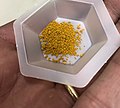 Alizarin Red S powder in a weighing boat
 -
 FP-C Patch


Alizarin Red S[edit]
Alizarin Red S is an organic compound with the chemical formula C14H7NaO7S. It is a sodium salt of alizarin sulfonic acid and is commonly used as a dye and a staining agent in various scientific applications.
Chemical Properties[edit]
Alizarin Red S is a derivative of alizarin, which is an anthraquinone dye. It is characterized by its bright red color and is soluble in water. The compound is known for its ability to form complexes with metal ions, which is a property that is exploited in its use as a biological stain.
Uses in Histology[edit]
In histology, Alizarin Red S is used to stain calcium deposits in tissues. This is particularly useful in the study of bone and cartilage, where it helps to visualize mineralization. The dye binds to calcium ions, forming a red complex that can be easily observed under a microscope.
Applications in Research[edit]
Alizarin Red S is widely used in biological research to study mineralization processes. It is often employed in experiments involving osteoblasts, the cells responsible for bone formation. Researchers use the dye to assess the extent of mineral deposition in cell cultures, which is an indicator of osteoblastic activity.
Related Compounds[edit]
Alizarin Red S is related to other anthraquinone dyes, such as alizarin and purpurin. These compounds share similar chemical structures and properties, making them useful in various staining and dyeing applications.
Safety and Handling[edit]
As with many chemical compounds, proper safety precautions should be taken when handling Alizarin Red S. It should be used in a well-ventilated area, and appropriate personal protective equipment, such as gloves and goggles, should be worn to prevent skin and eye contact.
Related Pages[edit]
| Branches of chemistry | ||||||||||
|---|---|---|---|---|---|---|---|---|---|---|
|
| Dyeing | ||||||||||
|---|---|---|---|---|---|---|---|---|---|---|
|
