Natural dye
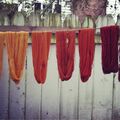
Natural dye refers to a type of dye derived from plants, invertebrates, or minerals. The majority of natural dyes are vegetable dyes from plant sources such as roots, berries, bark, leaves, and wood, and other organic sources such as fungi and lichens.
History[edit]
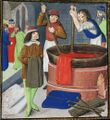
Archaeologists have found evidence of textile dyeing dating back to the Neolithic period. In many cases, the techniques used in dyeing, the dyes themselves, and the mordants (or substances that fix the dye to the textile) were kept secret by the dyers.
Types of Natural Dyes[edit]
Natural dyes can be sorted into three categories: direct dyes, mordant dyes, and vat dyes.
Direct Dyes[edit]
Direct dyes, also known as substantive dyes, are used with fibers like cotton or linen. These dyes require no mordant and are applied directly to the textile.
Mordant Dyes[edit]
Mordant dyes require a mordant, which is a chemical that combines with the dye and the fiber. Mordants often used include tannic acid, alum, urine, chrome alum, sodium chloride, and certain salts of aluminium, chromium, copper, iron, iodine, potassium, sodium, and tin.
Vat Dyes[edit]
Vat dyes are insoluble in water and cannot dye fibers directly. However, they can be converted into soluble form by reduction in alkaline solution, which allows the dye to affix to the fiber.
Uses[edit]
Natural dyes are used primarily for dyeing textiles but also have uses in printing inks and food colorings. They are also used in the production of many types of handicrafts, including batik, shibori, and ikat.
Environmental Impact[edit]
Natural dyes are generally considered more environmentally friendly than synthetic dyes. However, the cultivation of plants for natural dyes can have environmental impacts, and the mordants used with some natural dyes can be toxic.
See Also[edit]
 | This dye-related article is a stub. You can help WikiMD by expanding the page. |

-
 Natural_dye
 -
Natural_dye
-
 Natural_dye
 -
Natural_dye
-
Natural_dye
-
 Natural_dye
 -
Natural_dye
-
Natural_dye
-
Natural_dye
-
Natural_dye
-
Natural_dye
-
Natural_dye


Advertise on WikiMD — 81,000+ full articles, ~900,000 total pages, ~250 million page views. Global reach, limited time promotional rates from $1/page/day. Learn more · View stats

Translate page: - East Asian
中文,
日本,
한국어,
South Asian
हिन्दी,
தமிழ்,
తెలుగు,
Urdu,
ಕನ್ನಡ,
Southeast Asian
Indonesian,
Vietnamese,
Thai,
မြန်မာဘာသာ,
বাংলা
European
español,
Deutsch,
français,
Greek,
português do Brasil,
polski,
română,
русский,
Nederlands,
norsk,
svenska,
suomi,
Italian
Middle Eastern & African
عربى,
Turkish,
Persian,
Hebrew,
Afrikaans,
isiZulu,
Kiswahili,
Other
Bulgarian,
Hungarian,
Czech,
Swedish,
മലയാളം,
मराठी,
ਪੰਜਾਬੀ,
ગુજરાતી,
Portuguese,
Ukrainian
About WikiMD • Contact • Disclaimer • Privacy • Copyright • Site statistics
Some content and images may originate from Wikimedia Commons or Wikipedia and remain subject to their stated licenses. Unless otherwise noted, eligible WikiMD content is available under CC BY-SA 4.0.
WikiMD Wellnesspedia — Free health & wellness information for patients, students, and health professionals.


_2.jpg)
.jpg)
.jpg)
