Sufganiyah: Difference between revisions
CSV import Tags: mobile edit mobile web edit |
CSV import Tags: mobile edit mobile web edit |
||
| Line 24: | Line 24: | ||
{{Hanukkah}} | {{Hanukkah}} | ||
{{food-stub}} | {{food-stub}} | ||
<gallery> | |||
File:Classic_Hanukkah_sufganiyot.JPG|Sufganiyah | |||
File:Sufganiot.jpg|Sufganiyah | |||
File:Chocolate-vanilla_cream_sufganiyot.jpg|Sufganiyah | |||
File:Deep-frying_sufganiyot.jpg|Sufganiyah | |||
File:Sufganiyot_at_Mahane_Yehuda_shuk.jpg|Sufganiyah | |||
File:Sufganiyot-roladin.jpg|Sufganiyah | |||
File:PikiWiki_Israel_46141_Sarona_Market.JPG|Sufganiyah | |||
File:Safed_Jewish_Boy.jpg|Sufganiyah | |||
File:Flickr_-_Israel_Defense_Forces_-_2011_Hanukkah_Celebrations.jpg|Sufganiyah | |||
File:חנוכיה_לחנוכה.jpg|Sufganiyah | |||
File:Mini_sufganiyot.jpg|Sufganiyah | |||
File:Sufganiyah-Roland.jpg|Sufganiyah | |||
</gallery> | |||
Revision as of 12:07, 18 February 2025
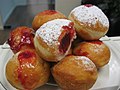
Sufganiyah (plural: Sufganiyot) is a round jelly doughnut eaten in Israel and around the world during the Jewish holiday of Hanukkah. The doughnut is deep-fried, filled with jelly or custard, and then topped with powdered sugar.
History
The tradition of eating fried foods during Hanukkah dates back to the Middle Ages, and is in commemoration of the miracle of the Menorah in the Second Temple in Jerusalem, where the oil that was supposed to last for one day lasted for eight days. The Sufganiyah, however, is a relatively recent addition to the Hanukkah tradition. The modern Israeli Sufganiyah was largely developed by the Histadrut, the Israeli labor federation, in the 1920s as a way to provide work for Jewish bakers.
Preparation
The dough for Sufganiyot is made from flour, sugar, yeast, and eggs. It is left to rise for a few hours, then rolled out and cut into circles. A spoonful of jelly or custard is placed in the center of each circle, and then another circle of dough is placed on top. The doughnuts are then deep-fried in hot oil, cooled, and dusted with powdered sugar.
Variations
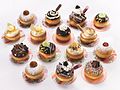
While the classic Sufganiyah is filled with red jelly, many variations have developed over the years. Some are filled with different types of jelly or jam, while others are filled with custard or chocolate cream. There are also Sufganiyot that are topped with colored sugar or glazed with chocolate.
Cultural Significance
In Israel, Sufganiyot are widely sold in bakeries and supermarkets during the weeks leading up to Hanukkah. They have become a symbol of the holiday, and eating them is a popular tradition. In recent years, the Sufganiyah has also gained popularity in other countries, particularly in areas with large Jewish populations.
See Also
| Jewish cuisine | ||||||||||
|---|---|---|---|---|---|---|---|---|---|---|
* Category
|

-
 Sufganiyah
 -
 Sufganiyah
 -
 Sufganiyah
 -
 Sufganiyah
 -
 Sufganiyah
 -
 Sufganiyah
 -
 Sufganiyah
 -
 Sufganiyah
 -
 Sufganiyah
 -
 Sufganiyah
 -
 Sufganiyah
 -
 Sufganiyah


