Teiglach
Teiglach is a traditional Jewish dessert most commonly associated with Rosh Hashanah, the Jewish New Year. The name "Teiglach" is derived from the Yiddish word "teig", which means dough, and the suffix "-lach", which is a diminutive. Thus, "Teiglach" can be loosely translated as "little pieces of dough".
History[edit]
Teiglach originated in the Lithuanian Jewish community, and it has been a staple of Ashkenazi Jewish cuisine for centuries. The dessert was traditionally prepared for special occasions, particularly for Rosh Hashanah, as its sweetness symbolizes the wish for a sweet new year.
Preparation[edit]
Teiglach is made by rolling pieces of dough into small balls, which are then boiled in a honey syrup until they become golden and sticky. The dough typically includes flour, eggs, and baking powder, while the syrup is made from honey, sugar, and often ginger for added flavor. Some variations of the recipe also include nuts, raisins, or candied fruit.
Once the dough balls are cooked and the syrup has thickened, the mixture is allowed to cool and harden into clusters. The result is a dessert that is both chewy and crunchy, with a sweet and slightly spicy flavor.
Cultural Significance[edit]
In addition to its role in Rosh Hashanah celebrations, Teiglach is also often served at other Jewish holidays and celebrations, such as Purim and Simchat Torah. Its long shelf life makes it a popular gift, and it is often included in Mishloach Manot, the gift baskets traditionally exchanged on Purim.
Despite its origins in the Lithuanian Jewish community, Teiglach has spread to Jewish communities around the world, and it is now a beloved dessert in many different cultures.
See Also[edit]
This Jewish dessert related article is a stub. You can help WikiMD by expanding it.

-
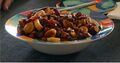 Teiglach, Traditional Ashkenazi Holiday Dish
 -
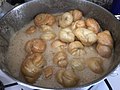 Teiglach boiled in honey
 -
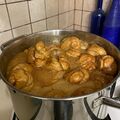 Browned teiglach boiling in honey
 -
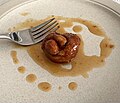 Single serving of teiglach


Medical Disclaimer: WikiMD is for informational purposes only and is not a substitute for professional medical advice. Content may be inaccurate or outdated and should not be used for diagnosis or treatment. Always consult your healthcare provider for medical decisions. Verify information with trusted sources such as CDC.gov and NIH.gov. By using this site, you agree that WikiMD is not liable for any outcomes related to its content. See full disclaimer.
Credits:Most images are courtesy of Wikimedia commons, and templates, categories Wikipedia, licensed under CC BY SA or similar.
Translate page: - East Asian
中文,
日本,
한국어,
South Asian
हिन्दी,
தமிழ்,
తెలుగు,
Urdu,
ಕನ್ನಡ,
Southeast Asian
Indonesian,
Vietnamese,
Thai,
မြန်မာဘာသာ,
বাংলা
European
español,
Deutsch,
français,
Greek,
português do Brasil,
polski,
română,
русский,
Nederlands,
norsk,
svenska,
suomi,
Italian
Middle Eastern & African
عربى,
Turkish,
Persian,
Hebrew,
Afrikaans,
isiZulu,
Kiswahili,
Other
Bulgarian,
Hungarian,
Czech,
Swedish,
മലയാളം,
मराठी,
ਪੰਜਾਬੀ,
ગુજરાતી,
Portuguese,
Ukrainian

