Thuringian sausage: Difference between revisions
CSV import |
CSV import Tags: mobile edit mobile web edit |
||
| Line 27: | Line 27: | ||
{{sausages}} | {{sausages}} | ||
{{food-stub}} | {{food-stub}} | ||
<gallery> | |||
File:Thüringer_Rostbratwurst.jpg|Thüringer Rostbratwurst | |||
File:Rostbrater.JPG|Rostbrater grilling sausages | |||
File:Wurstbude_für_Weimarer_Rostbratwürste.jpg|Wurstbude for Weimarer Rostbratwürste | |||
File:tannenwaelder001.jpg|Thuringian sausage | |||
</gallery> | |||
Latest revision as of 05:01, 18 February 2025
Thuringian sausage is a unique type of German sausage that originates from the Thuringia region in Germany. It is known for its distinctive flavor and high-quality ingredients.
History[edit]
The history of Thuringian sausage dates back to the 17th century. The first documented mention of the sausage was in 1613 in the city of Arnstadt, Thuringia. The sausage quickly gained popularity due to its unique taste and high-quality ingredients.
Ingredients[edit]
The main ingredients of Thuringian sausage are pork, beef, or veal. The meat is finely ground and mixed with a variety of spices, including salt, pepper, marjoram, caraway, and garlic. The mixture is then stuffed into natural casings and smoked over a wood fire.
Preparation[edit]
Thuringian sausage is traditionally grilled over a charcoal fire and served with mustard and bread. It can also be boiled, fried, or baked. The sausage is often served at barbecues and is a popular street food in Germany.
Cultural Significance[edit]
Thuringian sausage is not just a food item, but also a significant part of Thuringian culture. It is often served at festivals and celebrations, and is a symbol of the region's culinary heritage.
See Also[edit]
References[edit]
<references />
| German cuisine | ||||||||
|---|---|---|---|---|---|---|---|---|
This German cuisine related article is a stub.
|
| Sausage | ||||||||||
|---|---|---|---|---|---|---|---|---|---|---|
* Category
|

-
 Thüringer Rostbratwurst
 -
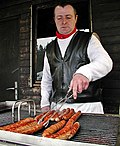 Rostbrater grilling sausages
 -
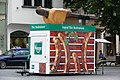 Wurstbude for Weimarer Rostbratwürste
 -
 Thuringian sausage


