Maids of honour tart: Difference between revisions
CSV import |
CSV import |
||
| Line 24: | Line 24: | ||
{{British cuisine}} | {{British cuisine}} | ||
{{food-stub}} | {{food-stub}} | ||
<gallery> | |||
File:Maids_of_Honour_Cakes.jpg|A selection of Maids of Honour cakes on a plate. | |||
File:Maids_of_honour.jpg|Close-up of a single Maids of Honour tart. | |||
File:Pederin_Synthesis.jpg|Chemical synthesis diagram related to Maids of Honour. | |||
</gallery> | |||
Latest revision as of 01:01, 18 February 2025
Maids of Honour Tart is a traditional British baked good, known for its rich, sweet flavour and delicate texture. The tart is believed to have originated in the 16th century, and is named after the Maids of Honour who served at the royal court.
History[edit]
The history of the Maids of Honour Tart is steeped in legend and tradition. It is said that the tart was first created by a cook in the household of Henry VIII. The king was so impressed by the tart that he named it after his Maids of Honour, the young women who attended the queen.
Ingredients and Preparation[edit]
The Maids of Honour Tart is made from a mixture of almond paste, sugar, butter, and egg yolk. The mixture is then spooned into a pastry shell and baked until golden. Some variations of the recipe also include currants or lemon zest for added flavour.
Cultural Significance[edit]
The Maids of Honour Tart holds a special place in British baking culture. It is often served at traditional afternoon teas, and is a popular choice for special occasions and celebrations. The tart is also a staple at many British bakeries, particularly those in the Richmond area, where it is said to have been popularised.
See Also[edit]
| British cuisine |
|---|
 |
| National cuisines |
| Regional cuisines |
| Overseas/Fusion cuisine |
| People |

-
 A selection of Maids of Honour cakes on a plate.
 -
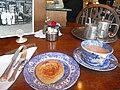 Close-up of a single Maids of Honour tart.
 -
 Chemical synthesis diagram related to Maids of Honour.


