Braided cheese: Difference between revisions
CSV import |
CSV import Tags: mobile edit mobile web edit |
||
| Line 33: | Line 33: | ||
{{Dairy-product-stub}} | {{Dairy-product-stub}} | ||
{{food-stub}} | {{food-stub}} | ||
<gallery> | |||
File:Geflochtener_Käse(Wien_Naschmarkt).JPG|Braided cheese | |||
</gallery> | |||
Revision as of 22:00, 16 February 2025
Braided Cheese is a type of cheese that is characterized by its distinctive plaited shape. It is a popular cheese variety in several cultures around the world, particularly in the Middle East, Eastern Europe, and Latin America.
History
The history of braided cheese dates back to ancient times. It is believed to have originated in the Middle East, where it is still widely consumed today. The cheese was traditionally made from sheep's milk or goat's milk, but today it is also commonly made from cow's milk.
Production
The production of braided cheese involves a unique process that gives the cheese its characteristic shape. The cheese curds are heated until they become stretchy, then they are pulled and twisted into a braid. This process is known as pasta filata, a method used in the production of several types of cheese, including mozzarella and provolone.
Varieties
There are several varieties of braided cheese, each with its own unique flavor and texture. Some of the most popular varieties include:
- Halloumi: A Cypriot cheese that is often served grilled or fried.
- Quesillo: A Mexican cheese that is commonly used in quesadillas and other traditional dishes.
- Kashkaval: A Bulgarian cheese that is often used in salads and pastries.
Consumption
Braided cheese is often consumed fresh, but it can also be aged for a more intense flavor. It is a versatile cheese that can be used in a variety of dishes, from salads and sandwiches to pastas and pizzas. In many cultures, braided cheese is also a popular choice for snacking.
See Also
| Cheese | ||||||||||
|---|---|---|---|---|---|---|---|---|---|---|
|
This dairy product related article is a stub. You can help WikiMD by expanding it.

-
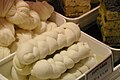 Braided cheese
.JPG)
