Artificial organ: Difference between revisions
CSV import |
CSV import |
||
| Line 1: | Line 1: | ||
{{Short description|Overview of the Arab world}} | |||
{{Use dmy dates|date=October 2023}} | |||
== | ==Arab World== | ||
The '''Arab world''' consists of 22 countries in the Middle East and North Africa, stretching from the Atlantic Ocean in the west to the Arabian Sea in the east, and from the Mediterranean Sea in the north to the Horn of Africa and the Indian Ocean in the southeast. The Arab world has a combined population of over 400 million people and encompasses a rich tapestry of cultures, languages, and histories. | |||
==Geography== | |||
The Arab world is geographically diverse, including vast deserts, fertile plains, and extensive coastlines. The region is often divided into three main areas: the [[Maghreb]] in the west, the [[Mashriq]] in the east, and the Arabian Peninsula. The [[Nile River]] and the [[Tigris–Euphrates river system]] are significant geographical features that have supported civilizations for millennia. | |||
== | ==Languages== | ||
The | The primary language spoken in the Arab world is [[Arabic]], which has numerous dialects and variations across different regions. Modern Standard Arabic is used in formal settings, media, and literature, while local dialects are used in everyday conversation. The diversity of Arabic dialects reflects the historical and cultural influences in each region. | ||
==Culture== | |||
The Arab world is known for its rich cultural heritage, which includes contributions to art, literature, science, and philosophy. The region is home to several [[World Heritage Sites]] and has a long tradition of [[poetry]], [[music]], and [[dance]]. The cultural practices and traditions vary widely across the Arab world, influenced by local customs, history, and religion. | |||
== | ===Religion=== | ||
[[Islam]] is the predominant religion in the Arab world, with the majority of the population adhering to the faith. The region is home to some of the most important Islamic holy sites, including [[Mecca]] and [[Medina]]. There are also significant [[Christian]] and [[Jewish]] communities, particularly in countries like [[Lebanon]], [[Egypt]], and [[Iraq]]. | |||
==Economy== | |||
The economies of the Arab world are diverse, ranging from oil-rich nations like [[Saudi Arabia]] and the [[United Arab Emirates]] to countries with more diversified economies like [[Egypt]] and [[Morocco]]. The region is a major global supplier of oil and natural gas, which has significantly influenced its economic development and geopolitical importance. | |||
== | ==Politics== | ||
The political landscape of the Arab world is varied, with different forms of government ranging from monarchies to republics. The region has experienced significant political changes in recent decades, including the [[Arab Spring]] uprisings that began in 2010, which led to political reforms and changes in leadership in several countries. | |||
==Education== | |||
Education systems in the Arab world vary widely, with some countries achieving high literacy rates and others facing challenges in providing access to quality education. Efforts are being made to improve educational infrastructure and increase enrollment, particularly for girls and women. | |||
==Related pages== | |||
* [[Middle East]] | |||
* [[North Africa]] | |||
* [[Islamic culture]] | |||
* [[Arab League]] | |||
==Gallery== | |||
<gallery> | |||
File:Arab World Green.svg|Map of the Arab world | |||
File:Arabic Varieties Map-2023.svg|Arabic dialects | |||
File:Eid in Morocco.JPG|Eid celebrations in Morocco | |||
File:Orthodox Easter celebrations in As-Suwayda.jpg|Orthodox Easter in As-Suwayda | |||
File:Girls lining up for class - Flickr - Al Jazeera English.jpg|Girls lining up for class | |||
File:International Women's Day in Egypt - Flickr - Al Jazeera English (97).jpg|International Women's Day in Egypt | |||
File:5628442718 b10fc2c47f o.jpg|Traditional architecture | |||
File:Masmak castle.jpg|Masmak Castle, Saudi Arabia | |||
File:Citadel of Qaitbay - Sea View.jpg|Citadel of Qaitbay, Egypt | |||
File:New Abdali 2024.png|New Abdali, Jordan | |||
File:Alger Grande-Poste IMG 0875.JPG|Grande Poste, Algiers | |||
File:Historical Jeddah.jpg|Historical Jeddah | |||
File:Old Medina, Casablanca, a view from United Nations square.JPG|Old Medina, Casablanca | |||
File:Sana'a, Yemen (14667934933).jpg|Sana'a, Yemen | |||
File:DubaiSkyline.JPG|Dubai skyline | |||
File:Great Mosque of Kairouan Panorama - Grande Mosquée de Kairouan Panorama.jpg|Great Mosque of Kairouan | |||
File:Ibrahim Pasha During his Final Years.jpg|Ibrahim Pasha | |||
File:Nasser, Arif and Ben Bella.jpg|Nasser, Arif, and Ben Bella | |||
File:Egyptianbridge.jpg|Bridge in Egypt | |||
File:Operation Chelcheragh (8).gif|Operation Chelcheragh | |||
File:Budaiya highway protest 08.JPG|Protest in Bahrain | |||
File:Oil and Gas Infrastructure Persian Gulf (large).gif|Oil and gas infrastructure | |||
File:SaddamStatue.jpg|Saddam Hussein statue | |||
File:Destroyed house in the south of Sanaa 12-6-2015-3.jpg|Destroyed house in Sanaa | |||
File:President Joe Biden stands with leaders of the GCC countries, Egypt, Iraq, and Jordan.jpg|President Joe Biden with Arab leaders | |||
File:Cairo-Nile-2020(1).jpg|Cairo and the Nile | |||
File:Dubai Marina Skyline.jpg|Dubai Marina | |||
File:Magrib.png|Map of the Maghreb | |||
File:Age-of-caliphs-xtra-space.png|Age of the Caliphs | |||
</gallery> | |||
[[Category:Arab world]] | |||
Revision as of 19:02, 11 February 2025
Overview of the Arab world
Arab World
The Arab world consists of 22 countries in the Middle East and North Africa, stretching from the Atlantic Ocean in the west to the Arabian Sea in the east, and from the Mediterranean Sea in the north to the Horn of Africa and the Indian Ocean in the southeast. The Arab world has a combined population of over 400 million people and encompasses a rich tapestry of cultures, languages, and histories.
Geography
The Arab world is geographically diverse, including vast deserts, fertile plains, and extensive coastlines. The region is often divided into three main areas: the Maghreb in the west, the Mashriq in the east, and the Arabian Peninsula. The Nile River and the Tigris–Euphrates river system are significant geographical features that have supported civilizations for millennia.
Languages
The primary language spoken in the Arab world is Arabic, which has numerous dialects and variations across different regions. Modern Standard Arabic is used in formal settings, media, and literature, while local dialects are used in everyday conversation. The diversity of Arabic dialects reflects the historical and cultural influences in each region.
Culture
The Arab world is known for its rich cultural heritage, which includes contributions to art, literature, science, and philosophy. The region is home to several World Heritage Sites and has a long tradition of poetry, music, and dance. The cultural practices and traditions vary widely across the Arab world, influenced by local customs, history, and religion.
Religion
Islam is the predominant religion in the Arab world, with the majority of the population adhering to the faith. The region is home to some of the most important Islamic holy sites, including Mecca and Medina. There are also significant Christian and Jewish communities, particularly in countries like Lebanon, Egypt, and Iraq.
Economy
The economies of the Arab world are diverse, ranging from oil-rich nations like Saudi Arabia and the United Arab Emirates to countries with more diversified economies like Egypt and Morocco. The region is a major global supplier of oil and natural gas, which has significantly influenced its economic development and geopolitical importance.
Politics
The political landscape of the Arab world is varied, with different forms of government ranging from monarchies to republics. The region has experienced significant political changes in recent decades, including the Arab Spring uprisings that began in 2010, which led to political reforms and changes in leadership in several countries.
Education
Education systems in the Arab world vary widely, with some countries achieving high literacy rates and others facing challenges in providing access to quality education. Efforts are being made to improve educational infrastructure and increase enrollment, particularly for girls and women.
Related pages
Gallery
-
 Map of the Arab world
 -
 Arabic dialects
 -
 Eid celebrations in Morocco
 -
 Orthodox Easter in As-Suwayda
 -
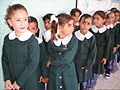 Girls lining up for class
 -
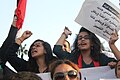 International Women's Day in Egypt
 -
Traditional architecture
-
Masmak Castle, Saudi Arabia
-
Citadel of Qaitbay, Egypt
-
New Abdali, Jordan
-
Grande Poste, Algiers
-
Historical Jeddah
-
Old Medina, Casablanca
-
Sana'a, Yemen
-
Dubai skyline
-
Great Mosque of Kairouan
-
Ibrahim Pasha
-
Nasser, Arif, and Ben Bella
-
Bridge in Egypt
-
Operation Chelcheragh
-
Protest in Bahrain
-
Oil and gas infrastructure
-
Saddam Hussein statue
-
Destroyed house in Sanaa
-
President Joe Biden with Arab leaders
-
Cairo and the Nile
-
Dubai Marina
-
Map of the Maghreb
-
Age of the Caliphs


.jpg)


.jpg)


.gif)

.gif)


.jpg)


