Breadstick: Difference between revisions
CSV import |
CSV import |
||
| Line 24: | Line 24: | ||
File:Breadstick Grissini.jpg|Breadstick Grissini | File:Breadstick Grissini.jpg|Breadstick Grissini | ||
File:Grissinistirati.jpg|Grissinistirati | File:Grissinistirati.jpg|Grissinistirati | ||
</gallery> | |||
<gallery> | |||
File:2016_1129_Turin_Grissini.jpg|Grissini in Turin | |||
File:Grissini.jpg|Traditional Grissini | |||
File:Grissinistirati.jpg|Stirato Grissini | |||
</gallery> | </gallery> | ||
Revision as of 01:16, 18 February 2025
Breadstick (also known as grissino or grissini) is a long, thin, crisp piece of bread that originated in Italy. Breadsticks can be served as an appetizer, a snack, or a side dish, and are often used in place of dinner rolls.
History
The breadstick is believed to have been created in the 14th century in the region of Piedmont, Italy. The original recipe was developed by a local baker to create a bread that could be stored for longer periods of time. The breadstick quickly became popular throughout Italy and eventually spread to other parts of Europe and the world.
Preparation
Breadsticks are typically made from a simple yeast dough that includes flour, water, salt, and sometimes sugar and butter. The dough is rolled out into thin strips, then baked until crisp. Some variations of the breadstick recipe may include different types of flour, such as whole wheat flour or rye flour, and additional ingredients like garlic, cheese, or herbs.
Varieties
There are many different varieties of breadsticks, including soft breadsticks, crisp breadsticks, and twisted breadsticks. Some breadsticks are topped with sesame seeds, poppy seeds, or cheese. In Italy, breadsticks are often served with prosciutto or other cured meats, while in the United States, they are commonly served with marinara sauce or olive oil for dipping.
In popular culture
Breadsticks have become a staple in many Italian restaurants, particularly in the United States. They are also commonly found in supermarkets and convenience stores.
See also

-
Breadstick Grissini
-
 Grissinistirati

-
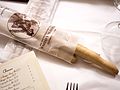 Grissini in Turin
 -
 Traditional Grissini
 -
Stirato Grissini


