Sohan halwa: Difference between revisions
CSV import Tags: mobile edit mobile web edit |
CSV import |
||
| Line 21: | Line 21: | ||
[[Category:Iranian desserts]] | [[Category:Iranian desserts]] | ||
{{Dessert-stub}} | {{Dessert-stub}} | ||
<gallery> | |||
File:Sohan_Halwa.JPG|Sohan halwa | |||
File:Multani-sohan-halwa.jpg|Multani sohan halwa | |||
File:Sohan_Halwa_at_Ghantewala_in_Chandni_Chowk,_Delhi.jpg|Sohan halwa at Ghantewala in Chandni Chowk, Delhi | |||
</gallery> | |||
Latest revision as of 04:07, 18 February 2025
Sohan Halwa is a traditional South Asian dessert, known for its rich, sweet, and dense texture. It is particularly popular in the Punjab and Sindh provinces of Pakistan, as well as in parts of India and Iran.
History[edit]
The origins of Sohan Halwa are traced back to the Mughal era, where it was a popular sweet dish among the royal families. The name "Sohan" is derived from the Persian word for "sweet", while "Halwa" is an Arabic term for "sweet confection".
Preparation[edit]
Sohan Halwa is made by boiling a mixture of water, sugar, and milk, to which cornflour is added to create a thick paste. This mixture is then cooked on a low heat until it solidifies. Ghee (clarified butter) is added during the cooking process to prevent the mixture from sticking to the pan and to give the halwa its distinctive rich flavor. The final product is often garnished with nuts such as almonds, pistachios, and walnuts.
Variations[edit]
There are several regional variations of Sohan Halwa. In Multan, a city in Pakistan, the halwa is famously made with milk, sugar, saffron, and a variety of nuts. This version is known for its unique disc shape and is often packaged in tin boxes for sale. In Iran, a similar sweet called Sohan is made with wheat sprout, sugar, rose water, and saffron.
Cultural Significance[edit]
Sohan Halwa is often served during festive occasions such as Eid al-Fitr, Diwali, and weddings. It is also a popular gift item during the winter season and is often bought by tourists as a souvenir.

-
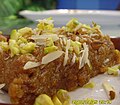
 Sohan halwa
 -
 Multani sohan halwa
 -
 Sohan halwa at Ghantewala in Chandni Chowk, Delhi


