Hirtenkäse: Difference between revisions
CSV import Tags: mobile edit mobile web edit |
CSV import |
||
| Line 22: | Line 22: | ||
{{Germany-food-stub}} | {{Germany-food-stub}} | ||
{{food-stub}} | {{food-stub}} | ||
== Hirtenkäse == | |||
<gallery> | |||
File:Heinrich_von_Zügel_-_Bauer_beim_Heimtrieb_der_Kühe.jpg|Bauer beim Heimtrieb der Kühe | |||
File:Vogt_(Allgäu_apotheke).JPG|Hirtenkäse | |||
</gallery> | |||
Latest revision as of 00:48, 18 February 2025
Hirtenkäse is a type of cheese that originates from Germany. It is a hard, aged cheese that is made from sheep's milk. The name "Hirtenkäse" translates to "herdsman's cheese" in English.
History[edit]
The history of Hirtenkäse dates back to the early Middle Ages, when it was first produced by shepherds in the Alpine regions of Germany. The cheese was traditionally made in small batches using the milk from the shepherds' own flocks.
Production[edit]
The production of Hirtenkäse begins with the collection of sheep's milk. The milk is then heated and rennet is added to cause the milk to curdle. The curdled milk is then cut into small pieces and heated again to remove the whey. The remaining curds are pressed into molds and aged for several months to develop the cheese's distinctive flavor and texture.
Characteristics[edit]
Hirtenkäse is known for its hard, crumbly texture and strong, tangy flavor. The cheese is typically pale yellow in color and has a natural rind. It is often used in cooking, particularly in dishes such as fondue and raclette, but can also be enjoyed on its own or with bread.
Varieties[edit]
There are several varieties of Hirtenkäse, each with its own unique characteristics. These include the Bergkäse, which is aged for a longer period of time and has a stronger flavor, and the Weichkäse, which is a softer version of the cheese.
See also[edit]
| Cheese | ||||||||||
|---|---|---|---|---|---|---|---|---|---|---|
|

This article is a Germany-food stub. You can help WikiMD by expanding it!

Hirtenkäse[edit]
-
 Bauer beim Heimtrieb der Kühe
 -
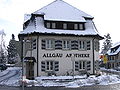 Hirtenkäse

.JPG)
