Scallion: Difference between revisions
No edit summary |
CSV import |
||
| Line 41: | Line 41: | ||
[[Category:Gardening]] | [[Category:Gardening]] | ||
{{stub-ag}} | {{stub-ag}} | ||
<gallery caption="Scallion"> | |||
File:CSA-Red-Spring-Onions.jpg|Red Spring Onions | |||
File:Germinating scallion.jpg|Germinating Scallion | |||
File:2010-06-19-supermarkt-by-RalfR-32.jpg|Scallions in Supermarket | |||
File:Chopped scallions.jpg|Chopped Scallions | |||
File:Haemul-pajeon 3.jpg|Haemul Pajeon with Scallions | |||
File:鶴亀堂 博多ネギバカチャーシュー.jpg|Scallion Topped Ramen | |||
File:Champ with pork and gravy (cropped).jpg|Champ with Scallions | |||
</gallery> | |||
Latest revision as of 00:53, 20 February 2025
A scallion is a young onion before the bulb has enlarged; plant having a large slender white bulb and flat overlapping dark green leaves; used in cooking; believed derived from the wild Allium ampeloprasum.
Introduction[edit]
The young onion, also known as a spring onion, scallion, or green onion, is a versatile ingredient in various cuisines worldwide. The slender white bulb and flat overlapping dark green leaves of the plant provide a mild onion flavor that adds depth and freshness to dishes. The young onion is considered a vegetable and is a member of the Allium genus, which also includes garlic, leeks, and chives.
History[edit]
The young onion is believed to have originated from the wild species Allium ampeloprasum, which is native to the Mediterranean region, Western Asia, and Middle East. Over time, the cultivation of onions spread across the globe, and young onions have become a staple ingredient in many culinary traditions.
Cultivation[edit]
Young onions are easy to grow and can be cultivated in a variety of climates. They require well-draining soil, full sun, and consistent moisture for optimal growth. Gardeners can plant onion sets, seeds, or transplants, with the latter being the most common method. Young onions are typically harvested when their bulbs are still slender and underdeveloped, usually within 8 to 12 weeks of planting.
Nutritional Value[edit]
Young onions are low in calories and high in nutrients, such as vitamin C, vitamin K, and vitamin A. They also contain dietary fiber, which aids in digestion and promotes a healthy gut. Additionally, young onions contain antioxidants, which help protect the body against free radicals and oxidative stress.
Culinary Uses[edit]
Young onions can be used in various dishes to enhance flavor and add a touch of color. They are commonly used in salads, stir-fries, soups, and as a garnish for various dishes. The white bulb has a slightly stronger flavor than the green leaves, which are milder and slightly sweet. Both parts of the plant can be eaten raw or cooked, depending on personal preference and the dish being prepared.
Some popular dishes featuring young onions include:
- Chinese scallion pancakes
- Japanese negi-yaki (grilled young onions)
- Mexican salsa verde
- Thai green curry
- American potato salad
Preservation[edit]
Young onions can be stored in the refrigerator for up to two weeks when wrapped in a damp paper towel and placed in a plastic bag. They can also be frozen or dried for longer-term storage.
See Also[edit]
- Scallion
-
 Red Spring Onions
 -
 Germinating Scallion
 -
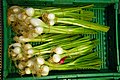 Scallions in Supermarket
 -
 Chopped Scallions
 -
 Haemul Pajeon with Scallions
 -
Scallion Topped Ramen
-
Champ with Scallions


.jpg)