Hünkârbeğendi: Difference between revisions
CSV import Tags: mobile edit mobile web edit |
CSV import |
||
| Line 23: | Line 23: | ||
{{Turkish cuisine}} | {{Turkish cuisine}} | ||
{{food-stub}} | {{food-stub}} | ||
<gallery> | |||
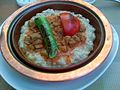
File:Hünkarbeğendi.jpg|Hünkârbeğendi | |||
</gallery> | |||
Latest revision as of 21:23, 20 February 2025
Hünkârbeğendi is a traditional Turkish dish that combines two key elements of the country's culinary heritage: meat and eggplant. The name Hünkârbeğendi translates to "the Sultan liked it", reflecting the dish's royal origins.
History[edit]
The dish is believed to have been created in the 17th century for Sultan Murad IV and has been a staple of Turkish cuisine ever since. The story goes that the Sultan enjoyed the dish so much that it was named Hünkârbeğendi, or "the Sultan liked it".
Ingredients and Preparation[edit]
The main ingredients in Hünkârbeğendi are lamb, eggplant, butter, milk, and kaşar cheese. The lamb is typically stewed until tender, while the eggplant is charred over an open flame, peeled, and then mashed. The mashed eggplant is then combined with butter and milk to create a creamy puree. The stewed lamb is served on top of the eggplant puree and the dish is often garnished with chopped parsley.
Variations[edit]
While lamb is the traditional meat used in Hünkârbeğendi, variations of the dish may use beef or chicken. Some modern interpretations of the dish also incorporate additional vegetables, such as bell peppers or tomatoes.
Cultural Significance[edit]
Hünkârbeğendi is not just a beloved dish in Turkey, but it also holds a significant place in the country's culinary history. It is often served at special occasions and is a common dish in many Turkish restaurants around the world.
See Also[edit]
| Turkish cuisine | ||||||||||
|---|---|---|---|---|---|---|---|---|---|---|
|


-
 Hünkârbeğendi

