Lingzhi (mushroom): Difference between revisions
CSV import |
CSV import |
||
| Line 31: | Line 31: | ||
{{Traditional Chinese medicine}} | {{Traditional Chinese medicine}} | ||
{{food-stub}} | {{food-stub}} | ||
<gallery> | |||
File:Jreishi2.jpg|Lingzhi mushroom | |||
File:Hokkaido_Reishi's_Deer_Horn_Shape_Reishi.JPG|Deer horn shape Reishi | |||
File:Ganoderic_acid.png|Ganoderic acid structure | |||
File:ChenhungshoGANODERMA.jpg|Lingzhi mushroom | |||
</gallery> | |||
Latest revision as of 04:52, 18 February 2025
Lingzhi (also known as Reishi in Japan and Yeongji in Korea) is a type of mushroom that is highly regarded in traditional Asian medicine. It is scientifically known as Ganoderma lucidum and belongs to the family Ganodermataceae.
Etymology[edit]
The term "Lingzhi" is derived from the Chinese language, where "Ling" means "spiritual" and "Zhi" means "mushroom". This reflects the ancient belief in the mushroom's ability to promote longevity and overall health.
Description[edit]
Lingzhi mushrooms are characterized by their glossy exterior, which can range in color from red to black. They are typically flat and kidney-shaped, with a distinctive spore print on the underside.
Cultivation[edit]
Lingzhi mushrooms are typically cultivated on hardwood logs or sawdust blocks, although they can also grow in the wild. The cultivation process can take several months, and requires specific temperature and humidity conditions.
Uses[edit]
Lingzhi mushrooms have been used in traditional Asian medicine for over 2,000 years. They are believed to boost the immune system, reduce stress, improve sleep, and promote overall health. However, scientific research into these potential benefits is ongoing.
Research[edit]
While the medicinal properties of Lingzhi mushrooms have been recognized in traditional medicine, scientific research is still in the early stages. Some studies suggest that Lingzhi may have anti-cancer properties, while others indicate potential benefits for heart health.
Safety[edit]
While Lingzhi mushrooms are generally considered safe for consumption, they can cause side effects in some individuals, including dry mouth, throat discomfort, and gastrointestinal upset. It is recommended to consult a healthcare provider before starting any new supplement regimen.
See Also[edit]
| Medicinal plants | ||||||||
|---|---|---|---|---|---|---|---|---|
This medicinal plants related article is a stub.
|
| Mushrooms | ||||||||||
|---|---|---|---|---|---|---|---|---|---|---|
|
| Traditional Chinese medicine (TCM) | ||||||
|---|---|---|---|---|---|---|
* Category
|

-
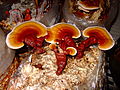 Lingzhi mushroom
 -
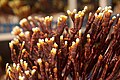 Deer horn shape Reishi
 -
 Ganoderic acid structure
 -
 Lingzhi mushroom


