Cheesecake
| A slice of cheesecake topped with strawberries | |
| Alternative names | |
| Type | Cake |
| Course | Dessert |
| Place of origin | |
| Region or state | |
| Associated national cuisine | |
| Created by | |
| Invented | |
| Cooking time | minutes to minutes |
| Serving temperature | |
| Main ingredients | Cream cheese, sugar, eggs, crust |
| Ingredients generally used | |
| Variations | |
| Food energy | kcal |
| Nutritional value | Protein: g, Fat: g, Carbohydrate: g |
| Glycemic index | |
| Similar dishes | |
| Other information | |
| Website | [ Official website] |
Cheesecake is a sweet dessert consisting of one or more layers. The main, and thickest layer, consists of a mixture of soft, fresh cheese, eggs, and sugar. If there is a bottom layer, it often consists of a crust or base made from crushed cookies, graham crackers, pastry, or sometimes sponge cake.
History[edit]
The history of cheesecake dates back to ancient Greece. The earliest attested mention of a cheesecake is by the Greek physician Aegimus, who wrote a book on the art of making cheesecakes. Cheesecake was also popular in ancient Rome; it was often served during special occasions.
Types[edit]
Cheesecakes can be broadly categorized into two types: baked and unbaked.
- Baked cheesecake: This type of cheesecake is baked in an oven. It often contains eggs which help it set during baking. New York-style cheesecake is a popular variety of baked cheesecake.
- Unbaked cheesecake: This type of cheesecake is set by chilling in the refrigerator. It often uses gelatin or other stabilizers to help it set.
Ingredients[edit]
The main ingredients in a cheesecake are:
- Cream cheese: Provides the creamy texture and rich flavor.
- Sugar: Adds sweetness to the dessert.
- Eggs: Used in baked cheesecakes to help set the mixture.
- Crust: Made from crushed cookies, graham crackers, or pastry.
Variations[edit]
There are many variations of cheesecake, including:
- New York-style cheesecake: Known for its rich and dense texture, made with cream cheese, eggs, sugar, and heavy cream.
- Japanese cheesecake: Known for its light and fluffy texture, often described as a cross between a cheesecake and a sponge cake.
- No-bake cheesecake: Made without baking, often using gelatin to set the filling.
Serving[edit]
Cheesecake is often served as a dessert and can be topped with a variety of ingredients, including:
- Fruit: Such as strawberries, blueberries, or raspberries.
- Chocolate: In the form of chocolate chips or chocolate sauce.
- Nuts: Such as almonds or pecans.
See also[edit]
References[edit]
External links[edit]
- Cheesecake on WikiMD
-
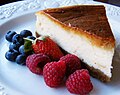 Cheesecake

Advertise on WikiMD — 81,000+ full articles, ~900,000 total pages, ~250 million page views. Global reach, limited time promotional rates from $1/page/day. Learn more · View stats

Medical Disclaimer: WikiMD is for informational purposes only and is not a substitute for professional medical advice. Content may be inaccurate or outdated and should not be used for diagnosis or treatment. Always consult your healthcare provider for medical decisions. Verify information with trusted sources such as CDC.gov and NIH.gov. By using this site, you agree that WikiMD is not liable for any outcomes related to its content. See full disclaimer.
Credits:Most images are courtesy of Wikimedia commons, and templates, categories Wikipedia, licensed under CC BY SA or similar.
Translate page: - East Asian
中文,
日本,
한국어,
South Asian
हिन्दी,
தமிழ்,
తెలుగు,
Urdu,
ಕನ್ನಡ,
Southeast Asian
Indonesian,
Vietnamese,
Thai,
မြန်မာဘာသာ,
বাংলা
European
español,
Deutsch,
français,
Greek,
português do Brasil,
polski,
română,
русский,
Nederlands,
norsk,
svenska,
suomi,
Italian
Middle Eastern & African
عربى,
Turkish,
Persian,
Hebrew,
Afrikaans,
isiZulu,
Kiswahili,
Other
Bulgarian,
Hungarian,
Czech,
Swedish,
മലയാളം,
मराठी,
ਪੰਜਾਬੀ,
ગુજરાતી,
Portuguese,
Ukrainian

