Sausage sandwich
Sausage sandwich is a type of sandwich that is made from sausages, usually served in a sliced bread roll or loaf. The sausage used can be of various types, including pork, beef, chicken, or vegetarian sausage. The sandwich may also include various condiments, sauces, vegetables, and cheese.
History[edit]
The sausage sandwich has a long history, with variations found in many different cultures. The concept of placing meat between bread dates back to ancient times. However, the modern sausage sandwich as we know it today has its roots in the Industrial Revolution in the United Kingdom, where it became a popular quick meal for workers.
Variations[edit]
There are many variations of the sausage sandwich around the world. In the United Kingdom, it is commonly served with onions, mustard, or brown sauce. In the United States, a popular variation is the Italian sausage sandwich, which includes Italian sausage, peppers, and onions. In Australia, the sausage sandwich is a staple at barbecues and is typically served with grilled onions and tomato sauce.
Preparation[edit]
The preparation of a sausage sandwich can vary greatly depending on the type of sausage and additional ingredients used. Generally, the sausage is cooked or grilled, then placed in a bread roll or loaf. Additional ingredients such as onions, peppers, or cheese may be added. The sandwich is often served hot, but can also be enjoyed cold.
Cultural significance[edit]
The sausage sandwich holds a significant place in many cultures. In the United Kingdom, it is a popular choice for breakfast, while in Australia, it is a common feature at community events and fundraisers, often referred to as a 'sausage sizzle'. In the United States, the Italian sausage sandwich is a staple at many Italian-American festivals and events.
See also[edit]

-
 Po'Boy Preservation Festival Hot Sausage Sandwich
 -
 Streetfood NY
 -
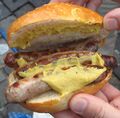 Drei im Weggla


Medical Disclaimer: WikiMD is for informational purposes only and is not a substitute for professional medical advice. Content may be inaccurate or outdated and should not be used for diagnosis or treatment. Always consult your healthcare provider for medical decisions. Verify information with trusted sources such as CDC.gov and NIH.gov. By using this site, you agree that WikiMD is not liable for any outcomes related to its content. See full disclaimer.
Credits:Most images are courtesy of Wikimedia commons, and templates, categories Wikipedia, licensed under CC BY SA or similar.
Translate page: - East Asian
中文,
日本,
한국어,
South Asian
हिन्दी,
தமிழ்,
తెలుగు,
Urdu,
ಕನ್ನಡ,
Southeast Asian
Indonesian,
Vietnamese,
Thai,
မြန်မာဘာသာ,
বাংলা
European
español,
Deutsch,
français,
Greek,
português do Brasil,
polski,
română,
русский,
Nederlands,
norsk,
svenska,
suomi,
Italian
Middle Eastern & African
عربى,
Turkish,
Persian,
Hebrew,
Afrikaans,
isiZulu,
Kiswahili,
Other
Bulgarian,
Hungarian,
Czech,
Swedish,
മലയാളം,
मराठी,
ਪੰਜਾਬੀ,
ગુજરાતી,
Portuguese,
Ukrainian

