Prostacyclin synthase
Prostacyclin synthase is an enzyme that in humans is encoded by the PTGIS gene. This enzyme belongs to the family of cytochrome P450 enzymes. It plays a crucial role in the biosynthesis of prostacyclin, a potent vasodilator and inhibitor of platelet aggregation.
Function[edit]
Prostacyclin synthase converts prostaglandin H2 (PGH2) to prostacyclin (PGI2). This reaction is a part of the eicosanoid synthesis pathway, which is essential for the production of various bioactive lipids that regulate a wide range of physiological processes, including inflammation, blood flow, and platelet function.
Structure[edit]
The prostacyclin synthase enzyme is a monomer with a molecular weight of approximately 55 kDa. It contains a heme prosthetic group, which is involved in the enzyme's catalytic activity.
Clinical significance[edit]
Alterations in prostacyclin synthase activity have been associated with various diseases, including cardiovascular disease, pulmonary hypertension, and cancer. In particular, decreased prostacyclin production due to reduced prostacyclin synthase activity is a common feature of atherosclerosis and thrombosis.
See also[edit]
References[edit]
 | This enzyme-related article is a stub. You can help WikiMD by expanding the page. |
-
Prostacyclin synthase structure from 2IAG
-
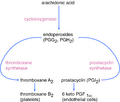 Thromboxane synthesis pathway
 -
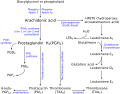 Eicosanoid synthesis pathways


Medical Disclaimer: WikiMD is for informational purposes only and is not a substitute for professional medical advice. Content may be inaccurate or outdated and should not be used for diagnosis or treatment. Always consult your healthcare provider for medical decisions. Verify information with trusted sources such as CDC.gov and NIH.gov. By using this site, you agree that WikiMD is not liable for any outcomes related to its content. See full disclaimer.
Credits:Most images are courtesy of Wikimedia commons, and templates, categories Wikipedia, licensed under CC BY SA or similar.
Translate page: - East Asian
中文,
日本,
한국어,
South Asian
हिन्दी,
தமிழ்,
తెలుగు,
Urdu,
ಕನ್ನಡ,
Southeast Asian
Indonesian,
Vietnamese,
Thai,
မြန်မာဘာသာ,
বাংলা
European
español,
Deutsch,
français,
Greek,
português do Brasil,
polski,
română,
русский,
Nederlands,
norsk,
svenska,
suomi,
Italian
Middle Eastern & African
عربى,
Turkish,
Persian,
Hebrew,
Afrikaans,
isiZulu,
Kiswahili,
Other
Bulgarian,
Hungarian,
Czech,
Swedish,
മലയാളം,
मराठी,
ਪੰਜਾਬੀ,
ગુજરાતી,
Portuguese,
Ukrainian


