Legionellales
Legionellales is an order of proteobacteria. It includes two families, the Legionellaceae and the Coxiellaceae. The bacteria in this order are gram-negative and are primarily intracellular parasites.
Legionellaceae[edit]
The Legionellaceae family includes the genus Legionella, which contains over 60 species. These bacteria are found in freshwater environments and can cause Legionnaires' disease and Pontiac fever when inhaled by humans. The most well-known species is Legionella pneumophila, which is the primary cause of Legionnaires' disease.
Coxiellaceae[edit]
The Coxiellaceae family includes the genus Coxiella, which contains the species Coxiella burnetii. This bacterium is the cause of Q fever, a disease that can be transmitted to humans by inhalation of dust contaminated by infected animals.
Pathogenesis[edit]
The bacteria in the Legionellales order are primarily intracellular parasites, meaning they live and reproduce inside host cells. They are able to survive and multiply within macrophages, a type of white blood cell. This allows them to evade the immune system and cause disease.
Treatment[edit]
Treatment for diseases caused by Legionellales bacteria typically involves antibiotics. For Legionnaires' disease, the antibiotics macrolides, quinolones, and rifampin are commonly used. For Q fever, the antibiotic doxycycline is typically used.
See also[edit]

This WikiMD article can only be edited by registered and verified editors. You can log in or register.
-
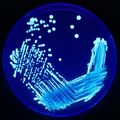 Legionella Plate 01

Advertise on WikiMD — 81,000+ full articles, ~900,000 total pages, ~250 million page views. Global reach, limited time promotional rates from $1/page/day. Learn more · View stats


Translate page: - East Asian
中文,
日本,
한국어,
South Asian
हिन्दी,
தமிழ்,
తెలుగు,
Urdu,
ಕನ್ನಡ,
Southeast Asian
Indonesian,
Vietnamese,
Thai,
မြန်မာဘာသာ,
বাংলা
European
español,
Deutsch,
français,
Greek,
português do Brasil,
polski,
română,
русский,
Nederlands,
norsk,
svenska,
suomi,
Italian
Middle Eastern & African
عربى,
Turkish,
Persian,
Hebrew,
Afrikaans,
isiZulu,
Kiswahili,
Other
Bulgarian,
Hungarian,
Czech,
Swedish,
മലയാളം,
मराठी,
ਪੰਜਾਬੀ,
ગુજરાતી,
Portuguese,
Ukrainian
About WikiMD • Contact • Disclaimer • Privacy • Copyright • Site statistics
Some content and images may originate from Wikimedia Commons or Wikipedia and remain subject to their stated licenses. Unless otherwise noted, eligible WikiMD content is available under CC BY-SA 4.0.
WikiMD Wellnesspedia — Free health & wellness information for patients, students, and health professionals.

