Iliac crest


The crest of the ilium (or iliac crest) stands as the superior border of the wing of ilium and the superolateral margin of the greater pelvis.
Structure[edit]
Spanning posteriorly from the anterior superior iliac spine (ASIS) to the posterior superior iliac spine (PSIS), the iliac crest subsequently divides behind the ASIS into two distinct lips – an outer and an inner – separated by the intermediate zone. The outer lip prominently swells laterally into the iliac tubercle.
The crest's entire length is palpable. It exhibits a superior convexity and a sinuous curvature – inwardly concave at the front and outwardly concave at the back. Its central portion is relatively thinner than its extremities.
Development[edit]

Originating from endochondral bone, the iliac crest undergoes various stages of development.
Function[edit]
Several muscles attach to the iliac crest:
- The outer lip serves as the attachment site for muscles including Tensor fasciae latae, Obliquus externus abdominis, and Latissimus dorsi, as well as the fascia lata throughout its length.
- The intermediate line attaches to Obliquus internus abdominis.
- The inner lip connects with iliac fascia, Transversus abdominis, Quadratus lumborum, Sacrospinalis, and Iliacus.
Muscles associated with the iliac crest include:
- Abdominal external oblique muscle
- Abdominal internal oblique muscle
- Transversus abdominis muscle
- Quadratus lumborum muscle
- Erector spinae
- Iliocostalis pars lumborum
- Longissimus pars thoracis[1]
- Latissimus dorsi
- Tensor fasciae latae
- Iliacus muscle
And the fasciae related to the iliac crest include:
Clinical significance[edit]
Being rich in red bone marrow, the iliac crest becomes a preferred site for bone marrow harvests (from both sides) to collect stem cells used in bone marrow transplantation. The iliac crest is also the most favored donor site for bone grafting when a significant quantity of bone is required. For instance, oral surgeons use bone from the iliac crest to treat substantial osseous defects in the oral cavity resulting from advanced periodontal disease, excessive bone resorption post tooth loss, trauma, or congenital defects like alveolar clefts.[2]
The peak of the iliac crests aligns with the level of the fourth lumbar vertebral body (L4). This is the level above or below which a lumbar puncture can be safely conducted.
Additional images[edit]
-
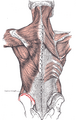 Muscles connecting the upper extremity to the vertebral column. Left iliac crest highlighted in red.
 -
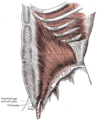 The Obliquus internus abdominis displayed.
 -
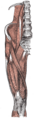 Muscles from the iliac and anterior femoral regions.
 -
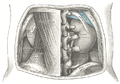 Positional relations of the kidneys viewed from the rear.
 -
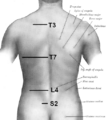 Iliac crest highlighted at center right.
 -
 Iliac crest visualization.


See also[edit]

| Bones of the pelvis | ||||||||||||||||||
|---|---|---|---|---|---|---|---|---|---|---|---|---|---|---|---|---|---|---|
|

Medical Disclaimer: WikiMD is for informational purposes only and is not a substitute for professional medical advice. Content may be inaccurate or outdated and should not be used for diagnosis or treatment. Always consult your healthcare provider for medical decisions. Verify information with trusted sources such as CDC.gov and NIH.gov. By using this site, you agree that WikiMD is not liable for any outcomes related to its content. See full disclaimer.
Credits:Most images are courtesy of Wikimedia commons, and templates, categories Wikipedia, licensed under CC BY SA or similar.
Translate page: - East Asian
中文,
日本,
한국어,
South Asian
हिन्दी,
தமிழ்,
తెలుగు,
Urdu,
ಕನ್ನಡ,
Southeast Asian
Indonesian,
Vietnamese,
Thai,
မြန်မာဘာသာ,
বাংলা
European
español,
Deutsch,
français,
Greek,
português do Brasil,
polski,
română,
русский,
Nederlands,
norsk,
svenska,
suomi,
Italian
Middle Eastern & African
عربى,
Turkish,
Persian,
Hebrew,
Afrikaans,
isiZulu,
Kiswahili,
Other
Bulgarian,
Hungarian,
Czech,
Swedish,
മലയാളം,
मराठी,
ਪੰਜਾਬੀ,
ગુજરાતી,
Portuguese,
Ukrainian

