Obturator crest
The Obturator Crest is a significant anatomical feature of the human body. It is a ridge on the pelvis that extends from the pubic tubercle to the acetabulum, the socket of the hip joint. The obturator crest is part of the obturator foramen, a large opening in the hip bone that allows for the passage of nerves and blood vessels.
Etymology[edit]
The term "obturator" comes from the Latin word "obturare", which means "to close or obstruct". This is in reference to the obturator foramen, which is largely closed off by a membrane in living beings. The term "crest" is derived from the Latin "crista", meaning "ridge or peak", which describes the shape of this anatomical feature.
Anatomy[edit]
The obturator crest is a prominent feature of the pubic bone, one of the three bones that make up the hip bone. It forms the anterior border of the obturator foramen and serves as the attachment point for the obturator membrane, a thin, fibrous sheet that covers most of the foramen.
The obturator crest begins at the pubic tubercle, a forward-projecting bump on the pubic bone, and extends to the acetabulum. The acetabulum is a deep, cup-shaped socket that houses the head of the femur, forming the hip joint.
Clinical Significance[edit]
The obturator crest, along with the rest of the obturator foramen, is of clinical importance in surgery and anatomy. It is a landmark used in surgical procedures involving the hip and pelvis, such as hip replacement surgery. The obturator crest can also be involved in certain medical conditions, such as obturator hernia, a rare type of abdominal hernia that occurs when part of the intestine protrudes through the obturator foramen.
Related Terms[edit]
- Obturator Foramen
- Obturator Membrane
- Obturator Nerve
- Obturator Artery
- Obturator Vein
- Obturator Canal

This WikiMD article can only be edited by registered and verified editors. You can log in or register.
-
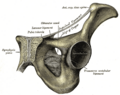 Gray's Anatomy Plate 435
 -
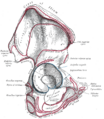 Gray's Anatomy Plate 235


Medical Disclaimer: WikiMD is for informational purposes only and is not a substitute for professional medical advice. Content may be inaccurate or outdated and should not be used for diagnosis or treatment. Always consult your healthcare provider for medical decisions. Verify information with trusted sources such as CDC.gov and NIH.gov. By using this site, you agree that WikiMD is not liable for any outcomes related to its content. See full disclaimer.
Credits:Most images are courtesy of Wikimedia commons, and templates, categories Wikipedia, licensed under CC BY SA or similar.
Translate page: - East Asian
中文,
日本,
한국어,
South Asian
हिन्दी,
தமிழ்,
తెలుగు,
Urdu,
ಕನ್ನಡ,
Southeast Asian
Indonesian,
Vietnamese,
Thai,
မြန်မာဘာသာ,
বাংলা
European
español,
Deutsch,
français,
Greek,
português do Brasil,
polski,
română,
русский,
Nederlands,
norsk,
svenska,
suomi,
Italian
Middle Eastern & African
عربى,
Turkish,
Persian,
Hebrew,
Afrikaans,
isiZulu,
Kiswahili,
Other
Bulgarian,
Hungarian,
Czech,
Swedish,
മലയാളം,
मराठी,
ਪੰਜਾਬੀ,
ગુજરાતી,
Portuguese,
Ukrainian

