Atmosphere of Earth
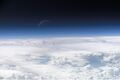
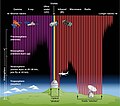
Atmosphere of Earth is the layer of gases, commonly known as air, that surrounds the Earth and is retained by Earth's gravity. The atmosphere of Earth protects life on Earth by creating pressure allowing for liquid water to exist on the Earth's surface, absorbing ultraviolet solar radiation, warming the surface through heat retention (greenhouse effect), and reducing temperature extremes between day and night (the diurnal temperature variation).
Composition[edit]
The atmosphere of Earth is a mixture of nitrogen (about 78%), oxygen (about 21%), argon (about 0.9%), carbon dioxide (0.04%) and other gases in trace amounts. Water vapor also is a significant constituent of Earth's atmosphere, though it varies in concentration from 0% in the cold polar regions to almost 4% in the tropics.
Structure[edit]
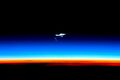
The atmosphere of Earth can be divided into five main layers. These are, from nearest to farthest from the Earth's surface:
- The Troposphere
- The Stratosphere
- The Mesosphere
- The Thermosphere
- The Exosphere
Weather and Climate[edit]
The weather and climate of Earth are driven by the atmospheric conditions. Weather refers to short-term changes in atmospheric conditions, while climate refers to long-term patterns.
Importance to Life[edit]
The atmosphere of Earth is vital for life as it provides oxygen for humans and animals to breathe, carbon dioxide for plants to photosynthesize, and protects life from harmful levels of solar radiation and cosmic rays.
See Also[edit]
 | This Earth-related article is a stub. You can help WikiMD by expanding the page. |
 | This article about atmospheric science is a stub. You can help WikiMD by expanding the page. |
 | This article related to a specific weather event is a stub. You can help WikiMD by expanding the page. |
-
 Atmosphere of Earth
 -
 Atmosphere of Earth
 -
 Atmosphere of Earth
 -
 Atmosphere of Earth
 -
 Atmosphere of Earth
 -
 Atmosphere of Earth
 -
 Atmosphere of Earth
 -
 Atmosphere of Earth
 -
 Atmosphere of Earth
 -
 Atmosphere of Earth
 -
 Atmosphere of Earth
 -
 Atmosphere of Earth


Medical Disclaimer: WikiMD is for informational purposes only and is not a substitute for professional medical advice. Content may be inaccurate or outdated and should not be used for diagnosis or treatment. Always consult your healthcare provider for medical decisions. Verify information with trusted sources such as CDC.gov and NIH.gov. By using this site, you agree that WikiMD is not liable for any outcomes related to its content. See full disclaimer.
Credits:Most images are courtesy of Wikimedia commons, and templates, categories Wikipedia, licensed under CC BY SA or similar.
Translate page: - East Asian
中文,
日本,
한국어,
South Asian
हिन्दी,
தமிழ்,
తెలుగు,
Urdu,
ಕನ್ನಡ,
Southeast Asian
Indonesian,
Vietnamese,
Thai,
မြန်မာဘာသာ,
বাংলা
European
español,
Deutsch,
français,
Greek,
português do Brasil,
polski,
română,
русский,
Nederlands,
norsk,
svenska,
suomi,
Italian
Middle Eastern & African
عربى,
Turkish,
Persian,
Hebrew,
Afrikaans,
isiZulu,
Kiswahili,
Other
Bulgarian,
Hungarian,
Czech,
Swedish,
മലയാളം,
मराठी,
ਪੰਜਾਬੀ,
ગુજરાતી,
Portuguese,
Ukrainian

