Dystrophic calcification
Dystrophic calcification is a form of calcification that occurs in damaged or necrotic tissue, despite normal serum calcium levels. This is in contrast to metastatic calcification, which occurs due to elevated serum calcium levels.
Pathogenesis[edit]
Dystrophic calcification is initiated by cell death, which leads to the release of intracellular calcium and phosphate ions. These ions combine to form hydroxyapatite crystals, which are deposited in the damaged tissue. The process is facilitated by the acidic environment created by cell death and inflammation.
Clinical significance[edit]
Dystrophic calcification can occur in a variety of tissues and organs, including the heart, lungs, kidneys, and blood vessels. It is often associated with chronic diseases such as atherosclerosis, rheumatoid arthritis, and tuberculosis. In the heart, it can lead to valvular heart disease and conduction system abnormalities. In the lungs, it can cause pulmonary fibrosis and respiratory failure. In the kidneys, it can result in renal failure.
Diagnosis[edit]
Diagnosis of dystrophic calcification is typically made through imaging studies such as X-ray, computed tomography (CT), and magnetic resonance imaging (MRI). These studies can reveal the presence and extent of calcification. Histological examination of tissue samples can also be used to confirm the diagnosis and determine the underlying cause.
Treatment[edit]
Treatment of dystrophic calcification is primarily aimed at managing the underlying condition causing the tissue damage. This may involve medication, surgery, or other interventions. In some cases, the calcified tissue may need to be surgically removed.
See also[edit]
_histopatholgy.jpg) | This article related to pathology is a stub. You can help WikiMD by expanding the page. |
-
 Dystrophic calcification in amyloidosis, H&E stain
 -
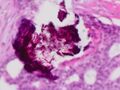 Histopathology of dystrophic microcalcifications in ductal carcinoma in situ
 -
 Cardiovascular calcification


Medical Disclaimer: WikiMD is for informational purposes only and is not a substitute for professional medical advice. Content may be inaccurate or outdated and should not be used for diagnosis or treatment. Always consult your healthcare provider for medical decisions. Verify information with trusted sources such as CDC.gov and NIH.gov. By using this site, you agree that WikiMD is not liable for any outcomes related to its content. See full disclaimer.
Credits:Most images are courtesy of Wikimedia commons, and templates, categories Wikipedia, licensed under CC BY SA or similar.
Translate page: - East Asian
中文,
日本,
한국어,
South Asian
हिन्दी,
தமிழ்,
తెలుగు,
Urdu,
ಕನ್ನಡ,
Southeast Asian
Indonesian,
Vietnamese,
Thai,
မြန်မာဘာသာ,
বাংলা
European
español,
Deutsch,
français,
Greek,
português do Brasil,
polski,
română,
русский,
Nederlands,
norsk,
svenska,
suomi,
Italian
Middle Eastern & African
عربى,
Turkish,
Persian,
Hebrew,
Afrikaans,
isiZulu,
Kiswahili,
Other
Bulgarian,
Hungarian,
Czech,
Swedish,
മലയാളം,
मराठी,
ਪੰਜਾਬੀ,
ગુજરાતી,
Portuguese,
Ukrainian

