Cioppino
Cioppino is a fish stew originating from San Francisco, California. It is an Italian-American dish and is considered a variation of various regional fish soups and stews of Italian cuisine.
History[edit]
Cioppino was developed in the late 1800s by Italian immigrants who fished off Meiggs Wharf and lived in the North Beach neighborhood of San Francisco, many from the port city of Genoa. When a fisherman came back empty handed, they would chowder up a pot with whatever they could get their hands on — typically, the catch of the day mixed with tomatoes and wine. It was then shared with others, especially other fishermen who had chipped in that day's catch.
Ingredients[edit]
Cioppino has a tomato base and is made with various types of fish and shellfish, including Dungeness crab, clams, shrimp, scallops, squid, mussels and fish. The seafood is then combined with fresh tomatoes in a wine sauce, and served with toasted bread, either local sourdough or French bread. The dish is comparable to other types of fish stew, such as the Italian cacciucco and brodetto, the Portuguese caldeirada, the Spanish zarzuela, and the French bouillabaisse.
Preparation[edit]
The dish is typically served with the shellfish still in the shell, including the crab, which is often served halved or quartered. It therefore requires special utensils (typically a crab fork and cracker), and a bib to prevent staining of clothing from the shellfish and the juice. The recipe calls for a "good white wine", and sourdough bread is usually served alongside.
See also[edit]
References[edit]
External links[edit]
- Cioppino recipe on the Food Network website.

This WikiMD article can only be edited by registered and verified editors. You can log in or register.
Cioppino[edit]
-
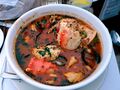 A bowl of cioppino with seafood and tomato broth.
 -
Close-up of cioppino served in San Francisco.


Medical Disclaimer: WikiMD is for informational purposes only and is not a substitute for professional medical advice. Content may be inaccurate or outdated and should not be used for diagnosis or treatment. Always consult your healthcare provider for medical decisions. Verify information with trusted sources such as CDC.gov and NIH.gov. By using this site, you agree that WikiMD is not liable for any outcomes related to its content. See full disclaimer.
Credits:Most images are courtesy of Wikimedia commons, and templates, categories Wikipedia, licensed under CC BY SA or similar.
Translate page: - East Asian
中文,
日本,
한국어,
South Asian
हिन्दी,
தமிழ்,
తెలుగు,
Urdu,
ಕನ್ನಡ,
Southeast Asian
Indonesian,
Vietnamese,
Thai,
မြန်မာဘာသာ,
বাংলা
European
español,
Deutsch,
français,
Greek,
português do Brasil,
polski,
română,
русский,
Nederlands,
norsk,
svenska,
suomi,
Italian
Middle Eastern & African
عربى,
Turkish,
Persian,
Hebrew,
Afrikaans,
isiZulu,
Kiswahili,
Other
Bulgarian,
Hungarian,
Czech,
Swedish,
മലയാളം,
मराठी,
ਪੰਜਾਬੀ,
ગુજરાતી,
Portuguese,
Ukrainian


.jpg)