Borderline personality disorder

Editor-In-Chief: Prab R Tumpati, MD
Obesity, Sleep & Internal medicine
Founder, WikiMD Wellnesspedia &
W8MD's weight loss doctor NYC
Philadelphia GLP-1 weight loss and GLP-1 clinic NYC
| Borderline personality disorder | |
|---|---|
| File:Edvard Munch - The Brooch. Eva Mudocci - Google Art Project.jpg | |
| Synonyms | N/A |
| Pronounce | N/A |
| Specialty | N/A |
| Symptoms | Emotional instability, impulsive behavior, distorted self-image, unstable relationships |
| Complications | N/A |
| Onset | Adolescence or early adulthood |
| Duration | Long-term |
| Types | N/A |
| Causes | Genetic and environmental factors |
| Risks | Childhood trauma, family history of mental disorders |
| Diagnosis | Based on clinical assessment |
| Differential diagnosis | Bipolar disorder, complex post-traumatic stress disorder, attention deficit hyperactivity disorder |
| Prevention | N/A |
| Treatment | Psychotherapy, medication |
| Medication | Antidepressants, mood stabilizers, antipsychotics |
| Prognosis | Variable; some improve with treatment |
| Frequency | Estimated 1.6% of the general population |
| Deaths | N/A |
Borderline personality disorder - a disorder characterized by an enduring pattern of unstable self image and mood together with volatile interpersonal relationships, self damaging impulsivity, recurrent suicidal threats or gestures and/or self mutilating behavior.
Clinical features[edit]
The major mental health disease known as borderline personality disorder, or BPD, is characterized by cycles of unstable and tumultuous emotions, impulsivity, and disordered relationships. It is not entirely clear what causes borderline personality disorder (BPD), but researchers believe that genetics, upbringing, and environmental factors all have a role.
Risk factors[edit]
The following are some of the risk factors for BPD:
- Abandonment throughout formative years (either childhood or adolescent)
- a lifestyle that is not conducive to family life.
- Ineffective lines of communication within the family
- A history of being abused sexually, physically, or emotionally
- BPD is more prevalent among females and people who have been hospitalized for psychiatric care, both of which are risk factors.
Symptoms[edit]
The following are examples of BPD symptoms:
- Problems with one's own sense of identity, as well as frequent shifts in one's interests and values
- A thinking style that is extremely binary, in which people and circumstances are viewed as being entirely positive or entirely negative.
- An intense fear of being abandoned, as well as an intolerance for spending time alone oneself
- Feelings of emptiness and boredom that occur frequently
- Expressions of rage that are not warranted
- Impertinence, including the use of substances or involvement in sexual relationships
- Crisis after crisis and repeated acts of self-harm, such as cutting or overdosing on medication.
Diagnosis[edit]
Typically, a psychological examination is used to diagnose BPD. This evaluation takes into account the patient's medical history as well as the severity of their symptoms.
Treatment[edit]
Individual talk therapy and group therapy are both possible modes of treatment for borderline personality disorder (BPD).
Medications[edit]
Medication may be used to treat comorbid illnesses such as depression or mood swings.
Prognosis[edit]
The prognosis for people who have borderline personality disorder (BPD) is generally optimistic with long-term treatment; however, this depends on the severity of the individual's disease as well as their desire to accept care.
Complications[edit]
Complications of borderline personality disorder can include mental health issues such as depression and substance addiction, difficulties at work, home, and in social settings, as well as attempts and successful terminations of one's own life.
Gallery[edit]
-
 Borderline Personality Disorder
 -
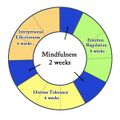 Dialectical Behavior Therapy Cycle
 -
Salomé


References[edit]
- American Psychiatric Association. (2013). Diagnostic and Statistical Manual of Mental Disorders, 5th Edition. (DSM-5).
- National Institute of Mental Health. (2021). Borderline Personality Disorder.
- National Alliance on Mental Illness. (2021). Borderline Personality Disorder.

This WikiMD article can only be edited by registered and verified editors. You can log in or register.
| Borderline personality disorder | ||||||||||
|---|---|---|---|---|---|---|---|---|---|---|
|
| Personality disorder classification | ||||||||||||||||
|---|---|---|---|---|---|---|---|---|---|---|---|---|---|---|---|---|
|

Medical Disclaimer: WikiMD is for informational purposes only and is not a substitute for professional medical advice. Content may be inaccurate or outdated and should not be used for diagnosis or treatment. Always consult your healthcare provider for medical decisions. Verify information with trusted sources such as CDC.gov and NIH.gov. By using this site, you agree that WikiMD is not liable for any outcomes related to its content. See full disclaimer.
Credits:Most images are courtesy of Wikimedia commons, and templates, categories Wikipedia, licensed under CC BY SA or similar.
Translate page: - East Asian
中文,
日本,
한국어,
South Asian
हिन्दी,
தமிழ்,
తెలుగు,
Urdu,
ಕನ್ನಡ,
Southeast Asian
Indonesian,
Vietnamese,
Thai,
မြန်မာဘာသာ,
বাংলা
European
español,
Deutsch,
français,
Greek,
português do Brasil,
polski,
română,
русский,
Nederlands,
norsk,
svenska,
suomi,
Italian
Middle Eastern & African
عربى,
Turkish,
Persian,
Hebrew,
Afrikaans,
isiZulu,
Kiswahili,
Other
Bulgarian,
Hungarian,
Czech,
Swedish,
മലയാളം,
मराठी,
ਪੰਜਾਬੀ,
ગુજરાતી,
Portuguese,
Ukrainian


