Adult neurogenesis
.jpg)
Adult neurogenesis refers to the process by which new neurons are formed in the brain of an adult. This phenomenon was once thought to occur only during development, but it is now known to persist in certain brain regions throughout life.
Overview[edit]
Adult neurogenesis primarily occurs in two regions of the brain: the subventricular zone (SVZ) of the lateral ventricles and the dentate gyrus of the hippocampus. These areas contain neural stem cells that can proliferate and differentiate into various types of neural cells.
Process[edit]
The process of adult neurogenesis involves several stages:
- Proliferation: Neural stem cells divide to produce progenitor cells.
- Differentiation: Progenitor cells differentiate into neurons, astrocytes, or oligodendrocytes.
- Migration: New neurons migrate to their final destinations within the brain.
- Integration: New neurons integrate into existing neural circuits, forming synapses and contributing to brain function.
Significance[edit]
Adult neurogenesis is believed to play a role in learning and memory, mood regulation, and brain plasticity. It is also implicated in the brain's response to injury and neurodegenerative diseases.
Factors Influencing Neurogenesis[edit]
Several factors can influence the rate of neurogenesis, including:
- Environmental Enrichment: Stimulating environments can enhance neurogenesis.
- Exercise: Physical activity is known to increase the production of new neurons.
- Stress: Chronic stress can negatively impact neurogenesis.
- Aging: The rate of neurogenesis declines with age.
Molecular Mechanisms[edit]

The regulation of adult neurogenesis involves complex signaling pathways and gene expression changes. Key molecules include:
- Brain-derived neurotrophic factor (BDNF): Promotes survival and differentiation of new neurons.
- Notch: Involved in maintaining the balance between stem cell proliferation and differentiation.
- Wnt: Regulates the proliferation and differentiation of neural progenitor cells.
Research and Implications[edit]
Research into adult neurogenesis has significant implications for understanding and treating neurological disorders. Enhancing neurogenesis could potentially aid in recovery from stroke, traumatic brain injury, and depression.
Related Pages[edit]
Gallery[edit]
-
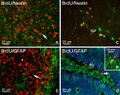 Phenotypes of proliferating cells in the Rostral Migratory Stream and Dentate Gyrus
 -
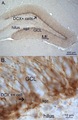 Doublecortin expression


Medical Disclaimer: WikiMD is for informational purposes only and is not a substitute for professional medical advice. Content may be inaccurate or outdated and should not be used for diagnosis or treatment. Always consult your healthcare provider for medical decisions. Verify information with trusted sources such as CDC.gov and NIH.gov. By using this site, you agree that WikiMD is not liable for any outcomes related to its content. See full disclaimer.
Credits:Most images are courtesy of Wikimedia commons, and templates, categories Wikipedia, licensed under CC BY SA or similar.
Translate page: - East Asian
中文,
日本,
한국어,
South Asian
हिन्दी,
தமிழ்,
తెలుగు,
Urdu,
ಕನ್ನಡ,
Southeast Asian
Indonesian,
Vietnamese,
Thai,
မြန်မာဘာသာ,
বাংলা
European
español,
Deutsch,
français,
Greek,
português do Brasil,
polski,
română,
русский,
Nederlands,
norsk,
svenska,
suomi,
Italian
Middle Eastern & African
عربى,
Turkish,
Persian,
Hebrew,
Afrikaans,
isiZulu,
Kiswahili,
Other
Bulgarian,
Hungarian,
Czech,
Swedish,
മലയാളം,
मराठी,
ਪੰਜਾਬੀ,
ગુજરાતી,
Portuguese,
Ukrainian

