Frontonasal dysplasia

Editor-In-Chief: Prab R Tumpati, MD
Obesity, Sleep & Internal medicine
Founder, WikiMD Wellnesspedia &
W8MD's weight loss doctor NYC
Philadelphia GLP-1 weight loss and GLP-1 clinic NYC
| Frontonasal dysplasia | |
|---|---|

| |
| Synonyms | Median cleft face syndrome, frontonasal malformation |
| Pronounce | N/A |
| Specialty | N/A |
| Symptoms | Hypertelorism, broad nasal bridge, cleft lip, cleft palate, craniofacial anomalies |
| Complications | Developmental delay, intellectual disability, vision problems |
| Onset | Congenital |
| Duration | Lifelong |
| Types | N/A |
| Causes | Genetic mutation |
| Risks | Family history of the condition |
| Diagnosis | Clinical examination, genetic testing |
| Differential diagnosis | Oculoauriculofrontonasal syndrome, craniofrontonasal dysplasia |
| Prevention | N/A |
| Treatment | Surgical intervention, speech therapy, occupational therapy |
| Medication | N/A |
| Prognosis | Varies depending on severity |
| Frequency | Rare |
| Deaths | N/A |
Frontonasal dysplasia (FND), also known as Median cleft face syndrome, is a rare genetic disorder that affects the development of the head and face before birth. The condition is characterized by abnormalities that can affect the nose, eyes, and upper lip.
Symptoms and Signs[edit]
The most common features of frontonasal dysplasia are widely spaced eyes (hypertelorism), a broad nose, a slit (cleft) in one or both nostrils (bifid nose), and a cleft lip and palate. Other features can include a widow's peak hairline, a flat or absent nasal bridge, and skin-covered gaps in the bones of the forehead (anterior cranial fossa meningocele).
Causes[edit]
Frontonasal dysplasia is caused by mutations in the ALX3, ALX4, and ZSWIM6 genes. These genes provide instructions for making proteins that are involved in the development of tissues and organs before birth. Mutations in these genes disrupt the normal development of the head and face, leading to the features of frontonasal dysplasia.
Diagnosis[edit]
Diagnosis of frontonasal dysplasia is based on a clinical examination and confirmed by genetic testing. Imaging tests such as X-rays, CT scans, and MRI can also be used to assess the severity of the condition.
Treatment[edit]
Treatment for frontonasal dysplasia is symptomatic and supportive. It often involves surgery to correct the facial abnormalities. Other treatments may include speech therapy for those with a cleft palate and special education services for those with learning disabilities.
Prognosis[edit]
The prognosis for individuals with frontonasal dysplasia varies. Some individuals have normal intelligence and lead normal lives, while others may have learning disabilities and require special education services.
Gallery[edit]
-
 Frontonasal dysplasia
 -
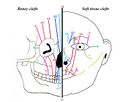 Tessier classification of craniofacial clefts
 -
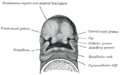 Diagram of the human skull


See also[edit]
References[edit]

Advertise on WikiMD — 81,000+ full articles, ~900,000 total pages, ~250 million page views. Global reach, limited time promotional rates from $1/page/day. Learn more · View stats

Medical Disclaimer: WikiMD is for informational purposes only and is not a substitute for professional medical advice. Content may be inaccurate or outdated and should not be used for diagnosis or treatment. Always consult your healthcare provider for medical decisions. Verify information with trusted sources such as CDC.gov and NIH.gov. By using this site, you agree that WikiMD is not liable for any outcomes related to its content. See full disclaimer.
Credits:Most images are courtesy of Wikimedia commons, and templates, categories Wikipedia, licensed under CC BY SA or similar.
Translate page: - East Asian
中文,
日本,
한국어,
South Asian
हिन्दी,
தமிழ்,
తెలుగు,
Urdu,
ಕನ್ನಡ,
Southeast Asian
Indonesian,
Vietnamese,
Thai,
မြန်မာဘာသာ,
বাংলা
European
español,
Deutsch,
français,
Greek,
português do Brasil,
polski,
română,
русский,
Nederlands,
norsk,
svenska,
suomi,
Italian
Middle Eastern & African
عربى,
Turkish,
Persian,
Hebrew,
Afrikaans,
isiZulu,
Kiswahili,
Other
Bulgarian,
Hungarian,
Czech,
Swedish,
മലയാളം,
मराठी,
ਪੰਜਾਬੀ,
ગુજરાતી,
Portuguese,
Ukrainian

