Baghdad School
Baghdad School is a term used to refer to a group of scholars, physicians, and philosophers who contributed to the Islamic Golden Age in Baghdad during the 8th to 13th centuries. The school was a significant center of learning and intellectual development, particularly in the fields of medicine, philosophy, and theology.
History[edit]
The Islamic Golden Age was a period of cultural, economic, and scientific growth in the history of the Islamic world, traditionally dated from the 8th century to the 14th century. During this time, the city of Baghdad was the capital of the Abbasid Caliphate, which was the center of learning and scholarship in the Islamic world. The Baghdad School was a significant part of this intellectual movement.
Contributions to Medicine[edit]
The scholars of the Baghdad School made significant contributions to the field of medicine. They translated and preserved the works of ancient Greek physicians such as Hippocrates and Galen, and also made their own original contributions. They developed new medical techniques, wrote influential medical textbooks, and established the first hospitals with a system of interns and externs.
Notable Figures[edit]
Some of the most notable figures associated with the Baghdad School include Al-Razi, also known as Rhazes, who was a pioneer in the field of ophthalmology; Ibn Sina, also known as Avicenna, who wrote the Canon of Medicine, a medical encyclopedia that served as a standard medical text in Europe and the Islamic world for centuries; and Al-Farabi, also known as Alpharabius, who was a renowned philosopher and scientist.
Legacy[edit]
The legacy of the Baghdad School is significant. The scholars of the school played a crucial role in preserving and expanding upon the knowledge of the ancient world. They laid the groundwork for many modern scientific and medical practices. Their works continue to be studied and respected in the fields of medicine, philosophy, and other disciplines.

-
 Grooming a horse, Kitab al-baytara 1210, Topkapi Museum
 -
 Materia Medica (Arabic translation, leaf)
 -
 Syrischer Maler des Kräuterbuchs des Dioskurides 001
 -
 Arabischer Maler des Kräuterbuchs des Dioskurides 001
 -
 Wild Cucumber in Arabic Dioscorides
 -
 Arabischer Maler des Kräuterbuchs des Dioskurides 002
 -
 Ruler in Turkic dress (long braids, fur hat, boots, fitting coat), in the Maqamat of al-Hariri, 1237 CE, probably Baghdad
 -
 Possible depiction of al-Hariri, in the Maqamat of al-Hariri, 1237 CE, probably Baghdad
 -
 Name of Caliph al-Mustansir in drawing of folio 164v Maqamat al-Hariri 1237 edition (BNF Arabe 5847)
 -
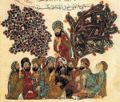 Maqamat Arabic

.jpg)


,_in_the_Maqamat_of_al-Hariri,_1237_CE,_probably_Baghdad.jpg)

.jpg)

Ad. Transform your life with W8MD's
GLP-1 weight loss injections special from $29.99 with insurance
|
WikiMD Medical Encyclopedia |
Medical Disclaimer: WikiMD is for informational purposes only and is not a substitute for professional medical advice. Content may be inaccurate or outdated and should not be used for diagnosis or treatment. Always consult your healthcare provider for medical decisions. Verify information with trusted sources such as CDC.gov and NIH.gov. By using this site, you agree that WikiMD is not liable for any outcomes related to its content. See full disclaimer.
Credits:Most images are courtesy of Wikimedia commons, and templates, categories Wikipedia, licensed under CC BY SA or similar.
Translate this page: - East Asian
中文,
日本,
한국어,
South Asian
हिन्दी,
தமிழ்,
తెలుగు,
Urdu,
ಕನ್ನಡ,
Southeast Asian
Indonesian,
Vietnamese,
Thai,
မြန်မာဘာသာ,
বাংলা
European
español,
Deutsch,
français,
Greek,
português do Brasil,
polski,
română,
русский,
Nederlands,
norsk,
svenska,
suomi,
Italian
Middle Eastern & African
عربى,
Turkish,
Persian,
Hebrew,
Afrikaans,
isiZulu,
Kiswahili,
Other
Bulgarian,
Hungarian,
Czech,
Swedish,
മലയാളം,
मराठी,
ਪੰਜਾਬੀ,
ગુજરાતી,
Portuguese,
Ukrainian
