Recreational diving
Recreational diving is a popular pastime that involves diving underwater for enjoyment and exploration, rather than for professional or industrial purposes. It is a form of underwater diving that includes various sub-disciplines such as scuba diving, snorkeling, free diving, and spearfishing.
History[edit]
The history of recreational diving dates back to the early 20th century, when the first diving helmets were developed. However, it was not until the invention of the aqualung by Jacques Cousteau and Emile Gagnan in the 1940s that recreational diving became widely accessible.
Equipment[edit]
Recreational divers typically use a range of equipment, including a dive mask to improve underwater vision, a dive regulator to control the pressure of breathing gas, dive fins for propulsion, and a dive computer to monitor depth and time. Divers may also use a buoyancy control device (BCD) to control their buoyancy underwater.
Safety[edit]
Safety is a major concern in recreational diving. Divers are trained to manage potential hazards, such as decompression sickness, oxygen toxicity, and hypothermia. Training organizations like PADI and NAUI provide courses on diving safety and emergency procedures.
Environmental Impact[edit]
Recreational diving can have an impact on the marine environment. Divers are encouraged to follow guidelines to minimize their impact, such as not touching or disturbing marine life, and not leaving any waste behind.
See Also[edit]
References[edit]
<references />
-
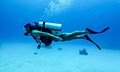 Discover Scuba Diving in St. Croix, US Virgin Islands
 -
 Diver and anemone, Monito Island, Puerto Rico
 -
 Junko Kitahama Apnea Monofin
 -
 Underwater photographer
 -
 Espalion - Musée du Scaphandre
 -
 Scuba diver in kelp forest
 -
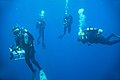 Dive Tulsa
 -
 Punta Diwata Reef
 -
 Scuba education levels
 -
 Divers under the boat at Hout Bay


.jpg)

.jpg)


Ad. Transform your life with W8MD's
GLP-1 weight loss injections special from $29.99 with insurance
|
WikiMD Medical Encyclopedia |
Medical Disclaimer: WikiMD is for informational purposes only and is not a substitute for professional medical advice. Content may be inaccurate or outdated and should not be used for diagnosis or treatment. Always consult your healthcare provider for medical decisions. Verify information with trusted sources such as CDC.gov and NIH.gov. By using this site, you agree that WikiMD is not liable for any outcomes related to its content. See full disclaimer.
Credits:Most images are courtesy of Wikimedia commons, and templates, categories Wikipedia, licensed under CC BY SA or similar.
Translate this page: - East Asian
中文,
日本,
한국어,
South Asian
हिन्दी,
தமிழ்,
తెలుగు,
Urdu,
ಕನ್ನಡ,
Southeast Asian
Indonesian,
Vietnamese,
Thai,
မြန်မာဘာသာ,
বাংলা
European
español,
Deutsch,
français,
Greek,
português do Brasil,
polski,
română,
русский,
Nederlands,
norsk,
svenska,
suomi,
Italian
Middle Eastern & African
عربى,
Turkish,
Persian,
Hebrew,
Afrikaans,
isiZulu,
Kiswahili,
Other
Bulgarian,
Hungarian,
Czech,
Swedish,
മലയാളം,
मराठी,
ਪੰਜਾਬੀ,
ગુજરાતી,
Portuguese,
Ukrainian
