Technical diving
Technical diving (often referred to as Tec diving) is a form of Scuba diving that exceeds the scope of recreational diving. Technical divers require advanced training, extensive experience, specialized equipment, and often breathe gas mixes other than air or standard nitrox. The activities may include deep diving, cave diving, wreck diving, and ice diving. These environments pose more hazards and greater risks, necessitating higher levels of expertise and safety measures.
Overview[edit]
Technical diving is diving beyond the recreational diving limits, diving deeper than 40 meters (130 feet), requiring staged decompression, diving in an overhead environment beyond 40 linear meters of the surface, and/or diving with accelerated decompression and/or the use of variable gas mixtures during the dive. Unlike recreational diving, which is primarily for enjoyment, technical diving often involves exploring environments that are out of reach for the majority of divers, such as deep reefs, shipwrecks, and caves.
Training and Certification[edit]
Technical diving requires specialized training to deal with the additional hazards encountered. Training courses are offered by several agencies, including Technical Diving International (TDI), Global Underwater Explorers (GUE), and the Professional Association of Diving Instructors (PADI) through their TecRec program. These courses cover topics such as advanced buoyancy control, gas management, emergency procedures, equipment configuration, and decompression theory.
Equipment[edit]
Technical diving equipment often includes multiple gas sources, including air, Nitrox, and Trimix (a mixture of oxygen, nitrogen, and helium) to allow for extended depth and bottom time. Divers may use a dive computer or dive tables for decompression planning. Other equipment includes redundant buoyancy control devices, multiple regulators, and often a rebreather to recycle the gas and extend underwater time.
Types of Technical Diving[edit]
- Deep Diving: Diving beyond the recreational limits of 40 meters (130 feet).
- Cave Diving: Exploration of underwater caves, requiring navigation skills and the ability to manage a guideline.
- Wreck Diving: Penetration of sunken vessels, which can involve navigating tight spaces and managing potential entanglements.
- Ice Diving: Diving under ice, which requires special procedures for entry, exit, and emergency scenarios.
Safety[edit]
Technical diving carries inherent risks, including decompression sickness, nitrogen narcosis, oxygen toxicity, and gas embolism. Divers must meticulously plan their dives, manage gas supplies, and be prepared for emergencies. The use of a buddy system and carrying redundant equipment is standard practice.
Environmental Considerations[edit]
Technical divers often explore sensitive underwater environments. Adhering to conservation principles, such as minimizing contact with marine life and preserving historical sites, is paramount.
Conclusion[edit]
Technical diving opens up new realms for exploration beneath the sea, allowing divers to visit places few have seen. However, it requires a significant commitment to training, equipment, and planning to ensure safety and protect underwater environments.
| Diving | ||||||||||
|---|---|---|---|---|---|---|---|---|---|---|
This diving-related article is a stub.
|
| Extreme and adventure sports | ||||||||||
|---|---|---|---|---|---|---|---|---|---|---|
|
 | This medical article is a stub. You can help WikiMD by expanding the page. |
-
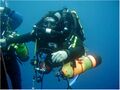 Trevor Jackson returns from SS Kyogle
 -
 Jeffrey Phillips Freeman before tech dive
 -
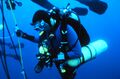 Technical diving
 -
 Jeffrey Phillips Freeman dives Sardigna nasello 34m
 -
 Tech diving decompression stop
 -
 Tec diver with sidemount tanks
 -
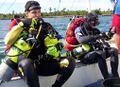 Decompression dive preparation
 -
 Tech diver at lake Iso-Melkutin Finland 2013


Sponsored Health Resource

W8MD Weight Loss, Sleep & MedSpa
Looking for physician-supervised weight loss, semaglutide, tirzepatide, or GLP-1 receptor agonist options? W8MD helps eligible patients in New York City, Brooklyn, New Jersey, Connecticut, Pennsylvania, Delaware, and greater Philadelphia with medical weight loss, sleep medicine, and long-term maintenance support.
GLP-1 specials: Affordable GLP-1 injections NYC and Philadelphia starting from $29.99/week and up for semaglutide with insurance accepted for qualifying visits, and $45/week and up for tirzepatide with insurance accepted for qualifying visits. Self-pay options start from $59.99/week and up for semaglutide and $69.99/week and up for tirzepatide.
- Medical weight loss NYC
- Affordable GLP-1 injections NYC
- Budget GLP-1 weight loss shots Philadelphia
- New Jersey medical weight loss
- NYC medical weight loss blog
- Philadelphia weight loss blog
- Sleep medicine and sleep apnea services
- W8MD MedSpa and wellness
Book a W8MD appointment · View GLP-1 specials
Paid promotional message. Eligibility, pricing, insurance coverage, medication availability, and results vary. Medical evaluation required.

Medical Disclaimer: WikiMD is for informational purposes only and is not a substitute for professional medical advice. Content may be inaccurate or outdated and should not be used for diagnosis or treatment. Always consult your healthcare provider for medical decisions. Verify information with trusted sources such as CDC.gov and NIH.gov. By using this site, you agree that WikiMD is not liable for any outcomes related to its content. See full disclaimer.
Credits:Most images are courtesy of Wikimedia commons, and templates, categories Wikipedia, licensed under CC BY SA or similar.
Translate page: - East Asian
中文,
日本,
한국어,
South Asian
हिन्दी,
தமிழ்,
తెలుగు,
Urdu,
ಕನ್ನಡ,
Southeast Asian
Indonesian,
Vietnamese,
Thai,
မြန်မာဘာသာ,
বাংলা
European
español,
Deutsch,
français,
Greek,
português do Brasil,
polski,
română,
русский,
Nederlands,
norsk,
svenska,
suomi,
Italian
Middle Eastern & African
عربى,
Turkish,
Persian,
Hebrew,
Afrikaans,
isiZulu,
Kiswahili,
Other
Bulgarian,
Hungarian,
Czech,
Swedish,
മലയാളം,
मराठी,
ਪੰਜਾਬੀ,
ગુજરાતી,
Portuguese,
Ukrainian

