Senegalese cuisine
Senegalese cuisine is the traditional cooking and food culture of the Senegalese people. It is characterized by its richness, diversity, and the variety of its dishes, which are influenced by the many ethnic groups present in the country, including the Wolof, Serer, Peulh, and Mandinka.
History[edit]
The history of Senegalese cuisine is deeply intertwined with the history of the country itself. The cuisine has been influenced by the various peoples who have lived in or traded with the region, including the Berbers, Arabs, Portuguese, French, and British. The cuisine has also been influenced by the country's geography, with the Atlantic Ocean providing a bounty of seafood, and the Sahel region providing grains and livestock.
Ingredients[edit]
The staple ingredients in Senegalese cuisine include millet, rice, corn, sorghum, peanuts, beans, yams, and okra. Seafood, particularly fish, is also a major component of many dishes. Meat, while not as prevalent, is still used in many dishes, particularly those of the Peulh and Mandinka peoples.
Dishes[edit]
One of the most well-known Senegalese dishes is Thieboudienne, a hearty fish and rice dish that is considered the national dish of Senegal. Other popular dishes include Yassa, a marinated chicken or fish dish; Maafe, a meat and vegetable stew thickened with peanuts; and Ceebu Jen, a rice and fish dish similar to Thieboudienne.
Beverages[edit]
Traditional Senegalese beverages include bissap, made from hibiscus flowers; bouye, made from the fruit of the baobab tree; and café Touba, a spiced coffee.
See also[edit]

-
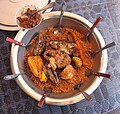 Thiéboudiène Boukhonk with tamarind
 -
 Yassa poulet
 -
 Ceebu Yapp
 -
 Couscous Senegalese thièré with chicken and sauce
 -
 Parkia biglobosa Soumbala
 -
 Senegalese cuisine
 -
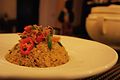 Acha (Fonio)


.jpg)
Ad. Transform your life with W8MD's
GLP-1 weight loss injections special from $29.99 with insurance
|
WikiMD Medical Encyclopedia |
Medical Disclaimer: WikiMD is for informational purposes only and is not a substitute for professional medical advice. Content may be inaccurate or outdated and should not be used for diagnosis or treatment. Always consult your healthcare provider for medical decisions. Verify information with trusted sources such as CDC.gov and NIH.gov. By using this site, you agree that WikiMD is not liable for any outcomes related to its content. See full disclaimer.
Credits:Most images are courtesy of Wikimedia commons, and templates, categories Wikipedia, licensed under CC BY SA or similar.
Translate this page: - East Asian
中文,
日本,
한국어,
South Asian
हिन्दी,
தமிழ்,
తెలుగు,
Urdu,
ಕನ್ನಡ,
Southeast Asian
Indonesian,
Vietnamese,
Thai,
မြန်မာဘာသာ,
বাংলা
European
español,
Deutsch,
français,
Greek,
português do Brasil,
polski,
română,
русский,
Nederlands,
norsk,
svenska,
suomi,
Italian
Middle Eastern & African
عربى,
Turkish,
Persian,
Hebrew,
Afrikaans,
isiZulu,
Kiswahili,
Other
Bulgarian,
Hungarian,
Czech,
Swedish,
മലയാളം,
मराठी,
ਪੰਜਾਬੀ,
ગુજરાતી,
Portuguese,
Ukrainian
