Libyan cuisine
Libyan Cuisine is the cooking traditions, practices, foods and dishes associated with the country of Libya. The cuisine derives much from the traditions of the Mediterranean, Berber, and Arab cultures.
Overview[edit]
Libyan cuisine is a mixture of the different Italian, Bedouin and traditional Arab culinary influences. The staple foods include couscous, pasta, and bread. Couscous is the most common staple food eaten by Libyans, it is a North African dish of small steamed balls of crushed durum wheat semolina that is traditionally served with a stew spooned on top.
Common Dishes[edit]
Some common Libyan dishes include Bazeen, Rice, Couscous, Asida, Shawarma, Makroudh, Hareesa, Mhalbi, Usban, Shorba, Batata Mubattana and Mbatten.
Bazeen[edit]
Bazeen is an unsweetened cake made from barley flour, water, salt and olive oil. It is formed into a dough, then placed in a circular mound on a dish and served with a tomato sauce, meat, vegetables and boiled eggs.
Couscous[edit]
Couscous is a staple food throughout the North African cuisines of Morocco, Algeria, Tunisia, Mauritania and Libya and to a lesser extent in the Middle East and Sicily.
Asida[edit]
Asida is a dish made up of a cooked wheat flour lump of dough, sometimes with added butter or honey.
Shawarma[edit]
Shawarma is a Middle Eastern meat preparation, where lamb, chicken, turkey, beef, veal, or mixed meats are placed on a spit, and may be grilled for as long as a day.
Beverages[edit]
Traditional Libyan drinks include Libyan tea, a thick, strong black tea that is often served with mint, and a drink made from dates or a lemon-infused drink that is often served with breakfast.
See also[edit]
| Libyan cuisine | ||||||||||
|---|---|---|---|---|---|---|---|---|---|---|
This Libyan cuisine related article is a stub.
|

-
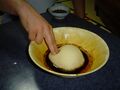 Asida, a traditional Libyan dish
 -
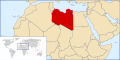 Map of Libya
 -
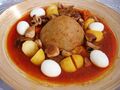 Bazin, a staple food in Libya
 -
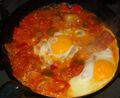 Shakshoka, a popular Libyan breakfast
 -
 Mebakbaka, a Libyan pasta dish


Medical Disclaimer: WikiMD is for informational purposes only and is not a substitute for professional medical advice. Content may be inaccurate or outdated and should not be used for diagnosis or treatment. Always consult your healthcare provider for medical decisions. Verify information with trusted sources such as CDC.gov and NIH.gov. By using this site, you agree that WikiMD is not liable for any outcomes related to its content. See full disclaimer.
Credits:Most images are courtesy of Wikimedia commons, and templates, categories Wikipedia, licensed under CC BY SA or similar.
Translate page: - East Asian
中文,
日本,
한국어,
South Asian
हिन्दी,
தமிழ்,
తెలుగు,
Urdu,
ಕನ್ನಡ,
Southeast Asian
Indonesian,
Vietnamese,
Thai,
မြန်မာဘာသာ,
বাংলা
European
español,
Deutsch,
français,
Greek,
português do Brasil,
polski,
română,
русский,
Nederlands,
norsk,
svenska,
suomi,
Italian
Middle Eastern & African
عربى,
Turkish,
Persian,
Hebrew,
Afrikaans,
isiZulu,
Kiswahili,
Other
Bulgarian,
Hungarian,
Czech,
Swedish,
മലയാളം,
मराठी,
ਪੰਜਾਬੀ,
ગુજરાતી,
Portuguese,
Ukrainian

