Gibanica
Gibanica is a traditional Serbian pastry dish, popular all over the Balkans. It is usually made with cheese and eggs, but there are many regional variations with other fillings like spinach, meat or sweet versions with apples or cherries.
History
The origins of Gibanica can be traced back to the Ottoman Empire, where similar types of pastry dishes were common. It was brought to the Balkans by the Ottomans and has since become a staple dish in Serbian cuisine.
Preparation
Gibanica is made by layering thin sheets of phyllo dough with a mixture of cheese (usually feta), eggs, and often yogurt or sour cream. Some variations include spinach, meat or fruit. The layers are then folded together and baked until golden brown.
Cultural Significance
Gibanica is not just a popular everyday dish, but also plays an important role in Serbian traditions and celebrations. It is often served at major events such as weddings, birthdays and religious holidays like Christmas and Easter.
Variations
There are many regional variations of Gibanica throughout the Balkans. In Bulgaria, a similar dish is known as Banitsa. In Croatia, it's called Strukli, and in Slovenia, it's known as Prekmurska gibanica, which is a sweet version filled with poppy seeds, walnuts, apples, raisins and cottage cheese.
See Also

-
 Gibanica single slice with full pie in background
 -
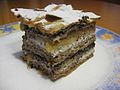 Prekmurska Gibanica
 -
Me_imurska gibanica served in Croatia


Ad. Transform your life with W8MD's
GLP-1 weight loss injections special from $29.99 with insurance
|
WikiMD Medical Encyclopedia |
Medical Disclaimer: WikiMD is for informational purposes only and is not a substitute for professional medical advice. Content may be inaccurate or outdated and should not be used for diagnosis or treatment. Always consult your healthcare provider for medical decisions. Verify information with trusted sources such as CDC.gov and NIH.gov. By using this site, you agree that WikiMD is not liable for any outcomes related to its content. See full disclaimer.
Credits:Most images are courtesy of Wikimedia commons, and templates, categories Wikipedia, licensed under CC BY SA or similar.
Translate this page: - East Asian
中文,
日本,
한국어,
South Asian
हिन्दी,
தமிழ்,
తెలుగు,
Urdu,
ಕನ್ನಡ,
Southeast Asian
Indonesian,
Vietnamese,
Thai,
မြန်မာဘာသာ,
বাংলা
European
español,
Deutsch,
français,
Greek,
português do Brasil,
polski,
română,
русский,
Nederlands,
norsk,
svenska,
suomi,
Italian
Middle Eastern & African
عربى,
Turkish,
Persian,
Hebrew,
Afrikaans,
isiZulu,
Kiswahili,
Other
Bulgarian,
Hungarian,
Czech,
Swedish,
മലയാളം,
मराठी,
ਪੰਜਾਬੀ,
ગુજરાતી,
Portuguese,
Ukrainian

.jpg)