Spotted dick

| British cuisine |
|---|
 |
| National cuisines |
| Regional cuisines |
| Overseas/Fusion cuisine |
| People |
Spotted Dick is a traditional British pudding, popular since the 19th century. It is made with suet and dried fruit (usually currants or raisins) and often served with custard. The dish is known for its distinctive name and its rich, hearty flavor.
History
The origins of Spotted Dick are somewhat unclear, but it is believed to have been popularized in the 19th century. The name "Spotted Dick" is first recorded in the Oxford English Dictionary in 1850, but similar recipes can be found in earlier cookbooks. The "spotted" part of the name refers to the dried fruit in the pudding, which appear as spots in the finished dish. The "dick" part of the name is less clear, but it may be a corruption of the word "dough" or "dickon", an old term for a type of pudding.
Preparation
Spotted Dick is made by mixing suet, flour, sugar, and dried fruit, then shaping the mixture into a roll or a round shape. The pudding is then steamed for several hours. Traditionally, Spotted Dick was wrapped in a cloth for steaming, but today it is often cooked in a pudding basin. The finished pudding is typically served with custard, although it can also be enjoyed on its own or with a dollop of cream.
Cultural Significance
Spotted Dick is a staple of British cuisine and is often associated with comfort food and nostalgia. It is frequently served in schools and hospitals, and it is a popular choice for celebrations and special occasions. Despite its somewhat humorous name, Spotted Dick is taken very seriously in culinary circles and is considered a classic example of British pudding.
See Also

-
 A traditional serving of Spotted Dick pudding.
 -
 Spotted Dick served at a Wikimeet in London, 2005.
 -
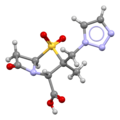 3D structure of Tazobactam, a beta-lactamase inhibitor.


Ad. Transform your life with W8MD's
GLP-1 weight loss injections special from $29.99 with insurance
|
WikiMD Medical Encyclopedia |
Medical Disclaimer: WikiMD is for informational purposes only and is not a substitute for professional medical advice. Content may be inaccurate or outdated and should not be used for diagnosis or treatment. Always consult your healthcare provider for medical decisions. Verify information with trusted sources such as CDC.gov and NIH.gov. By using this site, you agree that WikiMD is not liable for any outcomes related to its content. See full disclaimer.
Credits:Most images are courtesy of Wikimedia commons, and templates, categories Wikipedia, licensed under CC BY SA or similar.
Translate this page: - East Asian
中文,
日本,
한국어,
South Asian
हिन्दी,
தமிழ்,
తెలుగు,
Urdu,
ಕನ್ನಡ,
Southeast Asian
Indonesian,
Vietnamese,
Thai,
မြန်မာဘာသာ,
বাংলা
European
español,
Deutsch,
français,
Greek,
português do Brasil,
polski,
română,
русский,
Nederlands,
norsk,
svenska,
suomi,
Italian
Middle Eastern & African
عربى,
Turkish,
Persian,
Hebrew,
Afrikaans,
isiZulu,
Kiswahili,
Other
Bulgarian,
Hungarian,
Czech,
Swedish,
മലയാളം,
मराठी,
ਪੰਜਾਬੀ,
ગુજરાતી,
Portuguese,
Ukrainian
