Dyslexia
Neurological condition, developmental or acquired
| Dyslexia | |
|---|---|

| |
| Synonyms | Reading disorder, alexia |
| Pronounce | N/A |
| Field | Neurology, pediatrics |
| Symptoms | Trouble reading |
| Complications | |
| Onset | School age |
| Duration | |
| Types | N/A |
| Causes | Genetic and environmental factors |
| Risks | Family history, attention deficit hyperactivity disorder |
| Diagnosis | Series memory, spelling, vision, and reading test |
| Differential diagnosis | Hearing or vision problems, insufficient teaching |
| Prevention | |
| Treatment | Adjusting teaching methods |
| Medication | |
| Prognosis | |
| Frequency | 3–7% |
| Deaths | |
Clinical pharmacology is the scientific discipline focused on the study of drugs and their clinical applications. Anchored in the foundational knowledge of pharmacology, clinical pharmacology emphasizes the practical applications of pharmacological principles and methodologies. This includes the discovery and development of therapeutic agents, their effects in populations, and the interplay between drugs and the human body.
The role of clinical pharmacology is pivotal in bridging the gap between laboratory science and patient-centered medical practice. Its primary aims are to ensure the safe prescription of medications, optimize therapeutic outcomes, and reduce the potential for adverse reactions. Collaboration with pharmacists, who bring expertise in drug information, medication safety, and other relevant facets of pharmacy practice, is integral to the field.
Practitioners in clinical pharmacology, known as clinical pharmacologists, undergo rigorous training in both medicine and science. This equips them to critically assess evidence and contribute to the field through meticulously designed clinical studies. Clinical pharmacologists not only require a diverse outpatient population for clinical care, education, and research purposes but also benefit from the guidance of experienced medical specialists. Their patient-centric roles encompass monitoring adverse drug reactions, understanding therapeutic interventions, and exploring areas like toxicology, reproductive toxicology, cardiovascular risks, perioperative drug management, and psychopharmacology.
Furthermore, advancements in genetic, biochemical, and virotherapeutical techniques have greatly enhanced our understanding of the intricate mechanisms governing drug actions.
Branches
- Pharmacodynamics - Explores the effects of drugs on the body. While this encompasses cellular and molecular interactions, it also considers clinically relevant measurements. An illustrative example would be not just the molecular understanding of salbutamol, a beta2-adrenergic receptor agonist, but also assessing the peak flow rate in both healthy individuals and patients.
- Pharmacokinetics - Studies the journey of a drug within the body. This includes:
- Absorption - How drugs enter the bloodstream.
- Distribution - How drugs are distributed throughout the body.
- Metabolism - How drugs are chemically transformed in the body.
- Excretion - How drugs are eliminated from the body.
- Rational Prescribing - Encompasses the judicious use of medications, ensuring the appropriate drug, dose, route, and frequency of administration is selected for each patient, and terminating drug use when necessary.
- Adverse Drug Effects - Study of unwanted or harmful reactions resulting from medication use.
- Toxicology - The study of the adverse effects of chemicals on living organisms.
- Drug interactions - Understanding how different drugs or agents interact when administered together.
- Drug development - The comprehensive process of bringing a new pharmaceutical drug to market, often culminating in clinical trials.
 | |
|---|---|
 |
 |
| Dyslexia and related specific developmental disorders | ||||||||||||||||
|---|---|---|---|---|---|---|---|---|---|---|---|---|---|---|---|---|
|
-
 Children with dyslexia
 -
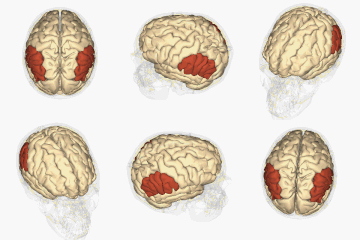 Animation of the inferior parietal lobule
 -
Dyslexia
-
 Diagram of the brain
 -
 Writing systems
 -
 PDF reader icon


Ad. Transform your health with W8MD Weight Loss, Sleep & MedSpa

Tired of being overweight?
Get started with evidence based, physician-supervised
affordable GLP-1 weight loss injections
Now available in New York City and Philadelphia:
- Semaglutide starting from $59.99/week and up
- Tirzepatide starting from $69.99/week and up (dose dependent)
✔ Evidence-based medical weight loss ✔ Insurance-friendly visits available ✔ Same-week appointments, evenings & weekends
Learn more:
Start your transformation today with W8MD weight loss centers.
|
WikiMD Medical Encyclopedia |
Medical Disclaimer: WikiMD is for informational purposes only and is not a substitute for professional medical advice. Content may be inaccurate or outdated and should not be used for diagnosis or treatment. Always consult your healthcare provider for medical decisions. Verify information with trusted sources such as CDC.gov and NIH.gov. By using this site, you agree that WikiMD is not liable for any outcomes related to its content. See full disclaimer.
Credits:Most images are courtesy of Wikimedia commons, and templates, categories Wikipedia, licensed under CC BY SA or similar.
Translate this page: - East Asian
中文,
日本,
한국어,
South Asian
हिन्दी,
தமிழ்,
తెలుగు,
Urdu,
ಕನ್ನಡ,
Southeast Asian
Indonesian,
Vietnamese,
Thai,
မြန်မာဘာသာ,
বাংলা
European
español,
Deutsch,
français,
Greek,
português do Brasil,
polski,
română,
русский,
Nederlands,
norsk,
svenska,
suomi,
Italian
Middle Eastern & African
عربى,
Turkish,
Persian,
Hebrew,
Afrikaans,
isiZulu,
Kiswahili,
Other
Bulgarian,
Hungarian,
Czech,
Swedish,
മലയാളം,
मराठी,
ਪੰਜਾਬੀ,
ગુજરાતી,
Portuguese,
Ukrainian
