Reading
.jpg)
.jpg)
.JPG)


Reading is the process of interpreting written symbols and comprehending the meaning of text. It is a fundamental skill that is essential for acquiring knowledge, communication, and functioning in society. Reading involves several cognitive processes, including decoding, comprehension, and fluency.
History of Reading[edit]
The history of reading dates back to ancient civilizations where early forms of writing, such as cuneiform and hieroglyphs, were developed. The invention of the printing press by Johannes Gutenberg in the 15th century revolutionized reading by making books more accessible to the general public.
Types of Reading[edit]
There are various types of reading, each serving different purposes:
- Skimming: Quickly reading through text to get a general idea of the content.
- Scanning: Looking for specific information within a text.
- Intensive Reading: Reading in detail with a focus on understanding and analyzing the text.
- Extensive Reading: Reading large amounts of text for pleasure or general understanding.
Reading Techniques[edit]
Effective reading techniques can enhance comprehension and retention of information. Some common techniques include:
- SQ3R: A method involving Survey, Question, Read, Recite, and Review.
- Active Reading: Engaging with the text through annotation, summarizing, and questioning.
- Speed Reading: Techniques aimed at increasing reading speed without sacrificing comprehension.
Reading and the Brain[edit]
Reading activates multiple areas of the brain, including the visual cortex, Broca's area, and Wernicke's area. These regions work together to process visual information, decode language, and understand meaning.
Benefits of Reading[edit]
Reading offers numerous benefits, including:
- Cognitive Development: Enhances vocabulary, critical thinking, and problem-solving skills.
- Mental Health: Reduces stress and improves mental well-being.
- Empathy: Increases understanding and empathy by exposing readers to different perspectives and experiences.
Challenges in Reading[edit]
Some individuals may face challenges in reading, such as:
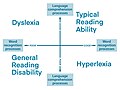
- Dyslexia: A learning disorder characterized by difficulties with accurate and/or fluent word recognition.
- Illiteracy: The inability to read or write, often due to lack of education or resources.
Promoting Reading[edit]
Various initiatives and programs aim to promote reading, such as:
- Literacy programs: Community-based programs that provide resources and support for improving literacy skills.
- Book clubs: Groups that encourage reading and discussion of books.
- Libraries: Institutions that provide access to books and other reading materials.
See Also[edit]
References[edit]
External Links[edit]


-
 Reading
 -
 Reading
 -
 Reading
 -
 Reading
 -
 Reading
 -
 Reading
 -
 Reading
 -
 Reading
 -
 Reading
 -
 Reading
 -
 Reading
 -
 Reading


.png)
Ad. Transform your health with W8MD Weight Loss, Sleep & MedSpa

Tired of being overweight?
Special offer:
Budget GLP-1 weight loss medications
- Semaglutide starting from $29.99/week and up with insurance for visit of $59.99 and up per week self pay.
- Tirzepatide starting from $45.00/week and up (dose dependent) or $69.99/week and up self pay
✔ Same-week appointments, evenings & weekends
Learn more:
- GLP-1 weight loss clinic NYC
- W8MD's NYC medical weight loss
- W8MD Philadelphia GLP-1 shots
- Philadelphia GLP-1 injections
- Affordable GLP-1 shots NYC
- Budget GLP-1 shots
|
WikiMD Medical Encyclopedia |
Medical Disclaimer: WikiMD is for informational purposes only and is not a substitute for professional medical advice. Content may be inaccurate or outdated and should not be used for diagnosis or treatment. Always consult your healthcare provider for medical decisions. Verify information with trusted sources such as CDC.gov and NIH.gov. By using this site, you agree that WikiMD is not liable for any outcomes related to its content. See full disclaimer.
Credits:Most images are courtesy of Wikimedia commons, and templates, categories Wikipedia, licensed under CC BY SA or similar.
Translate this page: - East Asian
中文,
日本,
한국어,
South Asian
हिन्दी,
தமிழ்,
తెలుగు,
Urdu,
ಕನ್ನಡ,
Southeast Asian
Indonesian,
Vietnamese,
Thai,
မြန်မာဘာသာ,
বাংলা
European
español,
Deutsch,
français,
Greek,
português do Brasil,
polski,
română,
русский,
Nederlands,
norsk,
svenska,
suomi,
Italian
Middle Eastern & African
عربى,
Turkish,
Persian,
Hebrew,
Afrikaans,
isiZulu,
Kiswahili,
Other
Bulgarian,
Hungarian,
Czech,
Swedish,
മലയാളം,
मराठी,
ਪੰਜਾਬੀ,
ગુજરાતી,
Portuguese,
Ukrainian
