SMC1A: Difference between revisions
CSV import |
CSV import |
||
| Line 32: | Line 32: | ||
{{Cell cycle}} | {{Cell cycle}} | ||
{{medicine-stub}} | {{medicine-stub}} | ||
<gallery> | |||
File:Structure of the interface between SMC3 (blue) and SMC1 (green) (PDB 2WD5) from mice (Kurze et al. 2009).png|Structure of the interface between SMC3 (blue) and SMC1 (green) (PDB 2WD5) from mice (Kurze et al. 2009) | |||
File:Structure of the interface between SMC1 (blue) and RAD21 (green) (PDB 1W1W) from budding yeast (Haering et al. 2004).png|Structure of the interface between SMC1 (blue) and RAD21 (green) (PDB 1W1W) from budding yeast (Haering et al. 2004) | |||
</gallery> | |||
Revision as of 05:13, 3 March 2025
SMC1A is a gene that encodes a protein involved in chromosome structure and DNA repair. Mutations in this gene are associated with Cornelia de Lange syndrome, a developmental disorder that affects many parts of the body.
Structure
The SMC1A gene is located on the X chromosome (Xp11.22-p11.21). It spans approximately 73 kilobases and comprises 25 exons. The encoded protein, SMC1A, is a member of the structural maintenance of chromosomes (SMC) family of proteins. These proteins form a complex that is essential for chromosome cohesion during cell division.
Function
SMC1A is a core component of the cohesin complex, which is crucial for chromosome segregation during cell division and DNA repair. The cohesin complex holds sister chromatids together until they are separated during anaphase. SMC1A, along with SMC3, forms a heterodimer that constitutes the core of the cohesin complex. This complex also includes RAD21 and either STAG1 or STAG2.
Clinical significance
Mutations in the SMC1A gene can cause Cornelia de Lange syndrome (CdLS), a rare genetic disorder characterized by slow growth, intellectual disability, and distinctive facial features. Most cases of CdLS are caused by mutations in the NIPBL gene, but approximately 5% of cases are due to mutations in SMC1A.
Research
Research into the SMC1A gene and its associated proteins continues to provide valuable insights into the mechanisms of chromosome segregation and DNA repair. Understanding these processes is crucial for developing treatments for diseases associated with chromosomal instability, such as cancer.
See also
References
<references />
| Genes on human chromosome X | ||||||
|---|---|---|---|---|---|---|
This human genetics related article is a stub.
|
| DNA repair | ||||||||||
|---|---|---|---|---|---|---|---|---|---|---|
* Category
|
| Cell cycle proteins | ||||||||||
|---|---|---|---|---|---|---|---|---|---|---|
|

-
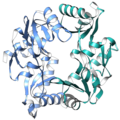 Structure of the interface between SMC3 (blue) and SMC1 (green) (PDB 2WD5) from mice (Kurze et al. 2009)
 -
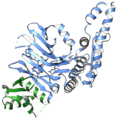 Structure of the interface between SMC1 (blue) and RAD21 (green) (PDB 1W1W) from budding yeast (Haering et al. 2004)
_and_SMC1_(green)_(PDB_2WD5)_from_mice_(Kurze_et_al._2009).png)
_and_RAD21_(green)_(PDB_1W1W)_from_budding_yeast_(Haering_et_al._2004).png)
