Bioplastic: Difference between revisions
CSV import |
CSV import |
||
| Line 28: | Line 28: | ||
{{Sustainable technologies}} | {{Sustainable technologies}} | ||
{{food-stub}} | {{food-stub}} | ||
<gallery> | |||
File:BiodegradablePlasticUtensils1.jpg|Biodegradable Plastic Utensils | |||
File:Flower_Wrapping_made_of_PLA-Blend_Bio-Flex.jpg|Flower Wrapping made of PLA-Blend Bio-Flex | |||
File:Bio-K_Abfallbeutel_Kompostbeutel_CG.jpg|Bio-K Abfallbeutel Kompostbeutel | |||
File:Stärke-Packstoff_Pömpel_CG.jpg|Stärke-Packstoff Pömpel | |||
File:Bio-K_Blister_CG.jpg|Bio-K Blister | |||
File:Edible_packaging_film.jpg|Edible Packaging Film | |||
File:Mulch_Film_made_of_PLA-Blend_Bio-Flex.jpg|Mulch Film made of PLA-Blend Bio-Flex | |||
File:Bottle_made_from_Cellulose_Acetate_Biograde.JPG|Bottle made from Cellulose Acetate Biograde | |||
</gallery> | |||
Latest revision as of 00:57, 27 February 2025
Bioplastic refers to a type of plastic derived from renewable biomass sources, such as vegetable fats and oils, corn starch, straw, woodchips, food waste, etc., rather than fossil-fuel plastics which are derived from petroleum. Some, but not all, bioplastics are designed to biodegrade.
History[edit]
The history of bioplastics dates back to the early 20th century. In the 1920s, Henry Ford experimented with soy-based plastics for car parts. However, the development of bioplastics did not take off until the late 1980s and early 1990s, when environmental concerns about traditional petroleum-based plastics began to rise.
Types of Bioplastics[edit]
There are several types of bioplastics, each with unique properties and applications. These include:
- Polylactic Acid (PLA): Derived from corn starch or sugar cane, PLA is often used in packaging and disposable cutlery.
- Polyhydroxyalkanoates (PHA): Produced by bacteria, PHA is used in packaging, agriculture, and medical applications.
- Starch Blends: These are often used in packaging, bags, and tableware.
Environmental Impact[edit]
The environmental impact of bioplastics is a complex issue. While they are derived from renewable sources, the production and disposal of bioplastics can still have environmental impacts. For example, the cultivation of crops for bioplastics can lead to deforestation and the overuse of pesticides. However, if managed responsibly, bioplastics can offer a more sustainable alternative to traditional plastics.
Future of Bioplastics[edit]
The future of bioplastics looks promising, with increasing interest in sustainable materials. Advances in technology and research are expected to improve the performance and reduce the cost of bioplastics, making them a viable alternative to petroleum-based plastics.
| Bioplastics | ||||||||||
|---|---|---|---|---|---|---|---|---|---|---|
This bioplastics-related article is a stub.
|
| Sustainable Technologies | ||||||||||
|---|---|---|---|---|---|---|---|---|---|---|
This sustainable technology related article is a stub.
|

-
 Biodegradable Plastic Utensils
 -
 Flower Wrapping made of PLA-Blend Bio-Flex
 -
 Bio-K Abfallbeutel Kompostbeutel
 -
 Stärke-Packstoff Pömpel
 -
 Bio-K Blister
 -
 Edible Packaging Film
 -
 Mulch Film made of PLA-Blend Bio-Flex
 -
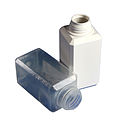 Bottle made from Cellulose Acetate Biograde


