Key lime: Difference between revisions
CSV import Tags: mobile edit mobile web edit |
CSV import |
||
| Line 22: | Line 22: | ||
[[Category:Flora of Florida]] | [[Category:Flora of Florida]] | ||
{{Citrus-stub}} | {{Citrus-stub}} | ||
== Key lime == | |||
<gallery> | |||
File:Lime_01.jpg|Lime 01 | |||
File:A_tree_full_of_key_limes_in_West_Bengal,_India.jpg|A tree full of key limes in West Bengal, India | |||
File:Map_of_inferred_original_wild_ranges_of_the_main_Citrus_cultivars,_and_selected_relevant_wild_taxa_(Fuller_et_al.,_2017).png|Map of inferred original wild ranges of the main Citrus cultivars, and selected relevant wild taxa (Fuller et al., 2017) | |||
File:Dayap_or_Philippine_keylime.jpg|Dayap or Philippine keylime | |||
File:keylime-flower.jpg|Keylime flower | |||
File:KeyLime_2010_07_25_0001.jpg|KeyLime 2010 07 25 0001 | |||
File:Starr_080610-8303_Citrus_aurantiifolia.jpg|Starr 080610-8303 Citrus aurantiifolia | |||
</gallery> | |||
Latest revision as of 21:08, 23 February 2025
Key Lime (Citrus aurantifolia) is a citrus species with a round fruit, 2.5–5 cm in diameter (1–2 in), that is yellow when ripe but usually picked green commercially. It is smaller, seedier, has a higher acidity, a stronger aroma, and a thinner rind than that of the Persian lime (Citrus x latifolia). It is valued for its unique flavor compared to other limes, with the key lime usually having a more tart and bitter flavor.
History[edit]
The Key lime is thought to be a hybrid of the micrantha lime (Citrus micrantha) and the citron (Citrus medica), both species introduced to the Americas by the Spanish explorers. Key lime is an integral part of the flora in the Florida Keys, hence the name.
Cultivation[edit]
Key limes are propagated from cuttings, with the tree being about 5 m (16 ft) high and with many thorny branches. The leaves are ovate 2.5–9 cm (1–3.5 in) long, resembling orange leaves. The flowers are 2.5 cm (1 in) in diameter, are yellowish white with a light purple tinge on the margins. Key limes are very cold-sensitive and are thus a predominant crop only in warm climates; they are naturalized in coastal areas of Texas, Mexico, and the Caribbean.
Uses[edit]
Key limes are used in a variety of products, including Key lime pie, cocktails, marinades, and salad dressings. The juice of the Key lime is highly acidic and has a strong, distinctive smell. The peel of the fruit has a unique aroma due to its limonene content.
See also[edit]

Key lime[edit]
-
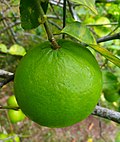 Lime 01
 -
 A tree full of key limes in West Bengal, India
 -
 Map of inferred original wild ranges of the main Citrus cultivars, and selected relevant wild taxa (Fuller et al., 2017)
 -
 Dayap or Philippine keylime
 -
 Keylime flower
 -
 KeyLime 2010 07 25 0001
 -
 Starr 080610-8303 Citrus aurantiifolia


.png)


