Phenolic content in tea: Difference between revisions
CSV import |
CSV import |
||
| Line 24: | Line 24: | ||
[[Category:Food science]] | [[Category:Food science]] | ||
{{food-stub}} | {{food-stub}} | ||
<gallery> | |||
File:Green_tea_3_appearances.jpg|Green tea 3 appearances | |||
File:Green_tea_UV_280_nm_spectrum.png|Green tea UV 280 nm spectrum | |||
File:Darjeeling-tea-first-flush-in-cup.jpg|Darjeeling tea first flush in cup | |||
</gallery> | |||
<gallery> | <gallery> | ||
File:Green_tea_3_appearances.jpg|Green tea 3 appearances | File:Green_tea_3_appearances.jpg|Green tea 3 appearances | ||
Latest revision as of 21:33, 20 February 2025
Phenolic Content in Tea
The phenolic content in tea refers to the quantity of phenolic compounds present in tea, a popular beverage derived from the leaves of the Camellia sinensis plant. Phenolic compounds, also known as polyphenols, are a group of chemical substances that are widely distributed in the plant kingdom and are abundant in tea leaves. They are responsible for the taste, color, and health benefits associated with tea consumption.
Types of Phenolic Compounds in Tea[edit]
The main types of phenolic compounds found in tea include flavonoids, tannins, and phenolic acids. Flavonoids, particularly catechins, are the most abundant phenolic compounds in tea, accounting for up to 30% of the dry weight of green tea leaves. Tannins contribute to the astringency of tea, while phenolic acids such as gallic acid and caffeic acid are also present in smaller quantities.
Health Benefits of Phenolic Compounds in Tea[edit]
Numerous studies have suggested that the phenolic compounds in tea may have various health benefits. These include antioxidant properties, potential anti-cancer effects, cardiovascular benefits, and anti-diabetic properties. The antioxidant activity of phenolic compounds is attributed to their ability to scavenge free radicals, thereby reducing oxidative stress in the body.
Factors Influencing Phenolic Content in Tea[edit]
Several factors can influence the phenolic content in tea, including the type of tea (e.g., green tea, black tea, oolong tea, white tea), the age of the tea leaves, the growing conditions, and the processing methods. For instance, green tea, which undergoes minimal processing, generally has a higher phenolic content than black tea, which is fully fermented.
See Also[edit]

-
 Green tea 3 appearances
 -
 Green tea UV 280 nm spectrum
 -
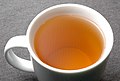 Darjeeling tea first flush in cup


-
Green tea 3 appearances
-
Green tea UV 280 nm spectrum
-
Darjeeling tea first flush in cup
