Tropisetron: Difference between revisions
No edit summary |
CSV import |
||
| Line 76: | Line 76: | ||
[[Category:Medicine]] | [[Category:Medicine]] | ||
{{medicine-stub}} | {{medicine-stub}} | ||
<gallery> | |||
File:Tropisetron2DACS.svg|Tropisetron 2D Structure | |||
File:Tropisetron3Dan.gif|Tropisetron 3D Animation | |||
</gallery> | |||
Latest revision as of 01:35, 20 February 2025
Medication used to treat nausea and vomiting
| Tropisetron | |
|---|---|

| |
| INN | |
| Drug class | |
| Routes of administration | Oral, Intravenous |
| Pregnancy category | |
| Bioavailability | |
| Metabolism | |
| Elimination half-life | |
| Excretion | |
| Legal status | |
| CAS Number | 89565-68-4 |
| PubChem | 5583 |
| DrugBank | DB00757 |
| ChemSpider | 5383 |
| KEGG | D00372 |
Tropisetron is a pharmaceutical drug used primarily as an antiemetic to treat nausea and vomiting caused by chemotherapy and radiotherapy. It is also used to prevent postoperative nausea and vomiting. Tropisetron is a selective 5-HT3 receptor antagonist, which means it works by blocking the action of serotonin at the 5-HT3 receptors.
Medical uses[edit]
Tropisetron is indicated for the prevention and treatment of nausea and vomiting induced by chemotherapy and radiotherapy. It is also used to prevent postoperative nausea and vomiting. The drug is administered either orally or intravenously.
Mechanism of action[edit]
Tropisetron works by selectively blocking the 5-HT3 receptors in the central nervous system and the gastrointestinal tract. By inhibiting the action of serotonin at these receptors, it prevents the activation of the vomiting reflex.
Pharmacokinetics[edit]
Tropisetron is well absorbed after oral administration. It undergoes hepatic metabolism and is excreted primarily via the kidneys. The elimination half-life of tropisetron is approximately 8 hours.
Side effects[edit]
Common side effects of tropisetron include headache, constipation, and dizziness. Rare but serious side effects may include allergic reactions and cardiac arrhythmias.
Contraindications[edit]
Tropisetron is contraindicated in patients with known hypersensitivity to the drug or any of its components. Caution is advised in patients with hepatic impairment or renal impairment.
See also[edit]
- Ondansetron
- Granisetron
- Palonosetron
- Chemotherapy-induced nausea and vomiting
- Postoperative nausea and vomiting

-
 Tropisetron 2D Structure
 -
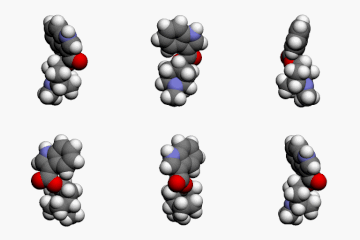 Tropisetron 3D Animation

