Raita: Difference between revisions
CSV import |
CSV import |
||
| Line 21: | Line 21: | ||
[[Category:Yogurt-based dishes]] | [[Category:Yogurt-based dishes]] | ||
{{food-stub}} | {{food-stub}} | ||
<gallery> | |||
File:Cucumber-raita.jpg|Cucumber Raita | |||
File:Onion Raita.jpg|Onion Raita | |||
File:Spring onion raitha.jpg|Spring Onion Raita | |||
File:Boondhi raita picture.JPG|Boondhi Raita | |||
File:Beetroot carrot raita picture.JPG|Beetroot Carrot Raita | |||
File:Raita Bhojpuri Lucknow Uttar Pradesh India.jpg|Raita Bhojpuri | |||
File:Cucumber and Tomato Raita.jpg|Cucumber and Tomato Raita | |||
File:Pomegranate raita.jpg|Pomegranate Raita | |||
File:Tawa pulao and boondi raita.JPG|Tawa Pulao and Boondi Raita | |||
</gallery> | |||
Latest revision as of 00:59, 20 February 2025
Raita is a condiment originating from the Indian subcontinent, commonly served with spicy dishes of Indian cuisine, Pakistani cuisine, and Bangladeshi cuisine. It is made by combining yogurt with a variety of vegetables, fruits, and sometimes spices, creating a dish that is both cooling and refreshing. Raita serves as an excellent counterbalance to the heat of spices used in South Asian cuisine, making it a staple side dish in many meals.
Ingredients and Variations[edit]
The base of raita is plain yogurt, which can be whisked to a smooth consistency. To this, a variety of ingredients can be added, depending on the regional recipe or personal preference. Common additions include:
- Cucumber: Probably the most well-known version, cucumber raita is prized for its refreshing taste.
- Onion: Adds a sharp, piquant flavor that contrasts well with the creamy yogurt.
- Tomato: Provides a juicy, tangy element to the dish.
- Boondi: Tiny, fried, spiced gram flour balls soaked in yogurt for a delightful crunch.
- Pineapple: For a sweet and savory version, often found in more festive or special meals.
- Spices: Such as cumin, mustard seeds, coriander, mint, and black salt, which are often used to enhance the flavor.
Preparation[edit]
The preparation of raita is straightforward and does not require cooking. The main ingredient, yogurt, is beaten to ensure a smooth texture. The chosen vegetables or fruits are then finely chopped or grated and mixed into the yogurt. Spices, both in ground and whole forms, may be roasted lightly in a pan to release their flavors before being added to the mixture. The raita is then chilled before serving to enhance its refreshing qualities.
Serving[edit]
Raita is typically served chilled as an accompaniment to main dishes. It is especially popular with biryani, pulao, and kebabs, where its coolness contrasts the spiciness of these dishes. It can also be enjoyed with chapati or naan as a refreshing side.
Cultural Significance[edit]
In the Indian subcontinent, raita holds a significant place not only as a food item but also in the cultural and dietary practices. It is often included in meals to ensure a balanced diet, combining the probiotic benefits of yogurt with the nutritional value of vegetables and fruits. During hot summers, raita is particularly valued for its cooling properties.
Health Benefits[edit]
Raita is considered a healthy addition to meals. Yogurt is a good source of probiotics, which are beneficial for gut health. The various vegetables and fruits added to raita are rich in vitamins, minerals, and dietary fiber, making it a nutritious choice.

-
 Cucumber Raita
 -
 Onion Raita
 -
 Spring Onion Raita
 -
 Boondhi Raita
 -
 Beetroot Carrot Raita
 -
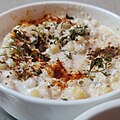 Raita Bhojpuri
 -
 Cucumber and Tomato Raita
 -
 Pomegranate Raita
 -
 Tawa Pulao and Boondi Raita


