Hemoglobinuria: Difference between revisions
m 1 revision imported |
CSV import |
||
| Line 67: | Line 67: | ||
{{genitourinary-disease-stub}} | {{genitourinary-disease-stub}} | ||
<gallery> | |||
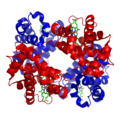
File:1GZX Haemoglobin.png|Hemoglobinuria | |||
</gallery> | |||
Latest revision as of 00:36, 20 February 2025
 | This article needs more reliable medical references for verification or relies too heavily on primary sources. (September 2017) |  |
| Hemoglobinuria | |
|---|---|

| |
| Synonyms | Haemoglobinuria |
| Pronounce | |
| Field | Urology, nephrology |
| Symptoms | |
| Complications | |
| Onset | |
| Duration | |
| Types | |
| Causes | |
| Risks | |
| Diagnosis | |
| Differential diagnosis | |
| Prevention | |
| Treatment | |
| Medication | |
| Prognosis | |
| Frequency | |
| Deaths | |
Hemoglobinuria is a condition in which the oxygen transport protein hemoglobin is found in abnormally high concentrations in the urine. The condition is often associated with any hemolytic anemia with primarily intravascular hemolysis, in which red blood cells (RBCs) are destroyed, thereby releasing free hemoglobin into the plasma. Excess hemoglobin is filtered by the kidneys, which excrete it into the urine, giving urine a purple color. Hemoglobinuria can lead to acute tubular necrosis which is an uncommon cause of a death of uni-traumatic patients recovering in the ICU .
Causes[edit]
- Acute glomerulonephritis
- Burns
- Renal cancer
- Malaria
- Paroxysmal nocturnal hemoglobinuria
- Microangiopathies, e.g. hemolytic-uremic syndrome (HUS), thrombotic thrombocytopenic purpura (TTP) leading to microangiopathic hemolytic anemia
- Transfusion reactions
- IgM autoimmune hemolytic anemia
- Glucose-6-phosphate dehydrogenase deficiency
- Pyelonephritis
- Sickle cell anemia
- Tuberculosis of the urinary tract
- March hemoglobinuria secondary to repetitive impacts on the body, usually the feet
- Athletic nephritis secondary to strenuous exercise
- Acute lead poisoning
Diagnosis[edit]
The diagnosis is often made based on the medical history, blood samples, and a urine sample. The absence of urine RBCs and RBC casts microscopically despite a positive dipstick test suggests hemoglobinuria or myoglobinuria. The medical term for RBCs in the urine is hematuria.
See also[edit]
References[edit]
<references group="" responsive="1"></references>
External links[edit]
| Components and results of urine tests | ||||||
|---|---|---|---|---|---|---|
|

-
 Hemoglobinuria
