Nuclear arms race: Difference between revisions
CSV import Tags: mobile edit mobile web edit |
CSV import |
||
| Line 30: | Line 30: | ||
{{Nuclear technology}} | {{Nuclear technology}} | ||
{{Military-stub}} | {{Military-stub}} | ||
<gallery> | |||
File:US_and_USSR_nuclear_stockpiles.svg|Nuclear arms race | |||
File:Jupiter_on_its_launch_pad.jpg|Jupiter missile on its launch pad | |||
File:Spirit_of_76_enroute_to_San_Clemente,_California,_with_General_Secretary_Brezhnev_-_NARA_-_194524_-_restored.jpg|Spirit of '76 en route to San Clemente with General Secretary Brezhnev | |||
File:Massale_vredesdemonstratie_in_Bonn_tegen_de_modernisering_van_kernwapens_in_West,_Bestanddeelnr_253-8611.jpg|Massive peace demonstration in Bonn against nuclear weapons modernization | |||
File:Reagan_and_Gorbachev_signing.jpg|Reagan and Gorbachev signing | |||
File:Obama_and_Medvedev_sign_Prague_Treaty_2010.jpeg|Obama and Medvedev sign Prague Treaty 2010 | |||
File:World_nuclear_weapons.png|World nuclear weapons | |||
File:Treaty_on_the_Prohibition_of_Nuclear_Weapons.svg|Treaty on the Prohibition of Nuclear Weapons | |||
</gallery> | |||
Latest revision as of 12:02, 18 February 2025
Nuclear Arms Race refers to the competition for supremacy in nuclear warfare between the United States, the Soviet Union, and their respective allies during the Cold War. This race began immediately after World War II, during the period from 1945 to 1991.
History[edit]
The nuclear arms race was primarily driven by the military policies of the United States and the Soviet Union. The first atomic bomb was developed by the United States during the Manhattan Project during World War II. The Soviet Union, not wanting to be left behind, initiated its own nuclear program, leading to the first successful detonation of a Soviet atomic bomb in 1949.
Impact[edit]
The nuclear arms race had significant impacts on global politics, economics, and society. It led to the development of a balance of power in international relations, as the threat of mutual assured destruction (MAD) prevented any direct full-scale conflicts between the nuclear-armed superpowers.
End of the Arms Race[edit]
The nuclear arms race ended with the dissolution of the Soviet Union in 1991. The Strategic Arms Reduction Treaty (START) was signed by the United States and the Soviet Union in 1991, marking the beginning of a series of disarmament agreements.
See Also[edit]
References[edit]
<references />
This article is a military-related stub. You can help WikiMD by expanding it!
-
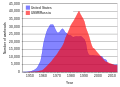 Nuclear arms race
 -
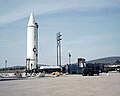 Jupiter missile on its launch pad
 -
 Spirit of '76 en route to San Clemente with General Secretary Brezhnev
 -
 Massive peace demonstration in Bonn against nuclear weapons modernization
 -
 Reagan and Gorbachev signing
 -
 Obama and Medvedev sign Prague Treaty 2010
 -
 World nuclear weapons
 -
Treaty on the Prohibition of Nuclear Weapons


