Korean War
The Korean War (Korean: 한국전쟁; Hanja: 韓國戰爭; RR: Hanguk Jeonjaeng; MR: Hanguk Chŏnjaeng), also known as the Fatherland Liberation War (Korean: 조국해방전쟁; Hanja: 祖國解放戰爭; RR: Joguk Haebang Jeonjaeng; MR: Choguk Haebang Chŏnjaeng), was a war fought in Korea from 1950 to 1953.
Background[edit]
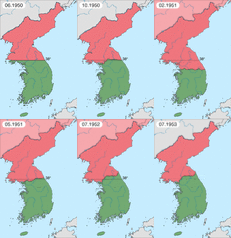
The war began on 25 June 1950 when North Korea, supported by the Soviet Union and China, invaded South Korea, which was supported primarily by the United States. The war ended in a stalemate with the signing of the Korean Armistice Agreement on 27 July 1953.
Course of the War[edit]
The war was marked by large-scale battles, such as the Battle of Inchon, and significant movements of troops and equipment. The war also saw the first combat use of nuclear weapons by the United States, although these were not used on the Korean peninsula.
Aftermath[edit]
The war resulted in the division of Korea into two separate states, with the border between them, the Korean Demilitarized Zone, becoming one of the most heavily militarized borders in the world. The war also had significant effects on the global geopolitical landscape, contributing to the Cold War and the rise of Communism in East Asia.
See also[edit]
References[edit]
External links[edit]

This WikiMD article can only be edited by registered and verified editors. You can log in or register.
-
 Korean War
 -
 A U.S. Marine tank follows a line of prisoners of war down a village street


Medical Disclaimer: WikiMD is for informational purposes only and is not a substitute for professional medical advice. Content may be inaccurate or outdated and should not be used for diagnosis or treatment. Always consult your healthcare provider for medical decisions. Verify information with trusted sources such as CDC.gov and NIH.gov. By using this site, you agree that WikiMD is not liable for any outcomes related to its content. See full disclaimer.
Credits:Most images are courtesy of Wikimedia commons, and templates, categories Wikipedia, licensed under CC BY SA or similar.
Translate page: - East Asian
中文,
日本,
한국어,
South Asian
हिन्दी,
தமிழ்,
తెలుగు,
Urdu,
ಕನ್ನಡ,
Southeast Asian
Indonesian,
Vietnamese,
Thai,
မြန်မာဘာသာ,
বাংলা
European
español,
Deutsch,
français,
Greek,
português do Brasil,
polski,
română,
русский,
Nederlands,
norsk,
svenska,
suomi,
Italian
Middle Eastern & African
عربى,
Turkish,
Persian,
Hebrew,
Afrikaans,
isiZulu,
Kiswahili,
Other
Bulgarian,
Hungarian,
Czech,
Swedish,
മലയാളം,
मराठी,
ਪੰਜਾਬੀ,
ગુજરાતી,
Portuguese,
Ukrainian

