Languages of India: Difference between revisions
CSV import Tags: mobile edit mobile web edit |
CSV import |
||
| Line 36: | Line 36: | ||
{{India-stub}} | {{India-stub}} | ||
{{Lang-stub}} | {{Lang-stub}} | ||
<gallery> | |||
File:KB_United_Kingdom.svg|Languages of India | |||
File:Gujarati_InScript_Keyboard_Layout.jpg|Gujarati InScript Keyboard Layout | |||
File:Danger_sign_in_India.jpeg|Danger sign in India | |||
File:Indo-Aryan_language_map.svg|Indo-Aryan language map | |||
File:Language_region_maps_of_India.svg|Language region maps of India | |||
File:Official_language_map_of_India_by_state_and_union_territory_(claimed_and_disputed_hatched).svg|Official language map of India by state and union territory | |||
File:Hindispeakers.png|Hindi speakers | |||
File:Indian_Languages_Map.jpg|Indian Languages Map | |||
File:Fastest_growing_languages_of_India_—_Hindi_(first),_Kashmiri_(second),_Gujarati_&_Meitei_alias_Manipuri_(third),_Bengali_(fourth)_—_based_on_2011_census_of_India.jpg|Fastest growing languages of India based on 2011 census | |||
File:South_Indian_languages.jpg|South Indian languages | |||
File:Illustrated_Manuscript_of_Dakhinpat_Sattra(_Bhagawat).jpg|Illustrated Manuscript of Dakhinpat Sattra (Bhagawat) | |||
</gallery> | |||
Latest revision as of 11:57, 18 February 2025
Languages of India refers to the numerous languages spoken in the Republic of India. As per the 2001 census of India, the country recognizes 122 major languages and 1599 other languages. However, the constitution of India recognizes 22 official languages, which include Assamese, Bengali, Gujarati, Hindi, Kannada, Kashmiri, Konkani, Malayalam, Marathi, Oriya, Punjabi, Sanskrit, Sindhi, Tamil, Telugu, Urdu, Bodo, Santhali, Maithili, and Dogri.
Official Languages[edit]
The Constitution of India designates the official language of the Indian government as Hindi written in the Devanagari script, as well as English. The constitution of India recognizes 22 official languages, termed as Scheduled languages.
Regional Languages[edit]
Each state in India has its own official language(s) in addition to the national official languages Hindi and English. The constitution allows for the use of these regional languages in legislative, administrative, and judicial purposes.
Linguistic Diversity[edit]
India is known for its linguistic diversity, with a wide range of languages spoken across its regions. The languages of India belong to several language families, the major ones being the Indo-Aryan languages spoken by 78.05% of Indians and the Dravidian languages spoken by 19.64% of Indians. Languages spoken by the remaining 2.31% of the population belong to the Austroasiatic, Sino-Tibetan, Tai-Kadai, and a few other minor language families and isolates.
Language Education[edit]
In India, the Three-language formula is implemented, which includes the learning of three languages that are: the mother tongue or regional language, the official language of the Union (Hindi), and an auxiliary language (English), to be taught in schools.
Preservation of Languages[edit]
The Government of India has taken several measures to preserve the rich diversity of languages in India. The Central Institute of Indian Languages (CIIL) is an Indian government institution that promotes linguistic harmony by teaching 15 Indian languages to non-native speakers.
See Also[edit]
- Indian literature
- List of endangered languages in India
- List of languages by number of native speakers in India
References[edit]
<references />
.svg)

-
 Languages of India
 -
 Gujarati InScript Keyboard Layout
 -
 Danger sign in India
 -
 Indo-Aryan language map
 -
 Language region maps of India
 -
 Official language map of India by state and union territory
 -
 Hindi speakers
 -
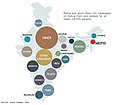 Indian Languages Map
 -
 Fastest growing languages of India based on 2011 census
 -
 South Indian languages
 -
 Illustrated Manuscript of Dakhinpat Sattra (Bhagawat)


.svg)


,_Kashmiri_(second),_Gujarati_%26_Meitei_alias_Manipuri_(third),_Bengali_(fourth)_%E2%80%94_based_on_2011_census_of_India.jpg)

.jpg)
