Japanese noodles: Difference between revisions
CSV import |
CSV import |
||
| Line 35: | Line 35: | ||
{{Noodles}} | {{Noodles}} | ||
{{food-stub}} | {{food-stub}} | ||
<gallery> | |||
File:Fresh_ramen_noodle_001.jpg|Fresh ramen noodles | |||
File:Japanese_Salt_flavor_Sapporo_Ramen.JPG|Japanese salt flavor Sapporo ramen | |||
File:Mori_soba_of_Fuji-soba.jpg|Mori soba of Fuji-soba | |||
File:Kamaage_udon,_at_Marugame_Seimen_(2013.06.01).jpg|Kamaage udon at Marugame Seimen | |||
</gallery> | |||
Latest revision as of 04:39, 18 February 2025
Japanese Noodles are a staple part of Japanese cuisine, with a variety of types and preparations. They are often served in soups or stir-fried dishes and are an integral part of many traditional Japanese meals.
Types of Japanese Noodles[edit]
Udon is a type of thick, wheat-based noodle. It is often served hot in a mild, soy-based broth, but can also be served cold with a dipping sauce.
Soba is a thin, brown noodle made from buckwheat flour. It can be served hot in a soup or cold with a dipping sauce. Soba noodles are traditionally eaten on New Year's Eve in Japan.
Ramen is a Chinese-style noodle that has been adapted to Japanese tastes. It is typically served in a meat or fish-based broth, often flavored with soy sauce or miso, and uses toppings such as sliced pork, dried seaweed, and green onions.
Somemen are thin, white, wheat-based noodles. They are typically served cold in the summer with a light, flavorful dipping sauce.
Yakisoba are wheat-based noodles that are stir-fried with bite-sized pork and finely chopped vegetables like cabbage, onions, and carrots. It is seasoned with yakisoba sauce, salt and pepper.
Preparation and Serving[edit]
Japanese noodles can be served in a variety of ways. They can be served hot in a soup, chilled and served with a dipping sauce, or stir-fried. The type of noodle used often depends on the season, with lighter, chilled noodles being popular in the summer and heavier, hot noodle dishes being preferred in the winter.
Cultural Significance[edit]
Noodles have a significant cultural role in Japan. They are often associated with certain celebrations or times of year. For example, eating soba noodles on New Year's Eve is a tradition that is believed to bring good luck and longevity.
See Also[edit]
| Japanese cuisine 日本料理 |
|---|
|
|
| Noodles | ||||||||||||||||||||||||||||
|---|---|---|---|---|---|---|---|---|---|---|---|---|---|---|---|---|---|---|---|---|---|---|---|---|---|---|---|---|
* Category
|

-
 Fresh ramen noodles
 -
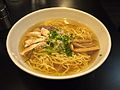 Japanese salt flavor Sapporo ramen
 -
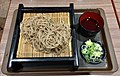 Mori soba of Fuji-soba
 -
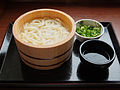 Kamaage udon at Marugame Seimen


.jpg)
