Gibanica: Difference between revisions
CSV import |
CSV import |
||
| Line 27: | Line 27: | ||
[[Category:Balkan cuisine]] | [[Category:Balkan cuisine]] | ||
{{food-stub}} | {{food-stub}} | ||
<gallery> | |||
File:Gibanica_single_slice_with_full_pie_in_background.jpg|Gibanica single slice with full pie in background | |||
File:PrekmurskaGibanica1.JPG|Prekmurska Gibanica | |||
File:Me_imurska_gibanica_-_servirana_(Croatia).jpg|Me_imurska gibanica served in Croatia | |||
</gallery> | |||
Revision as of 04:06, 18 February 2025
Gibanica is a traditional Serbian pastry dish, popular all over the Balkans. It is usually made with cheese and eggs, but there are many regional variations with other fillings like spinach, meat or sweet versions with apples or cherries.
History
The origins of Gibanica can be traced back to the Ottoman Empire, where similar types of pastry dishes were common. It was brought to the Balkans by the Ottomans and has since become a staple dish in Serbian cuisine.
Preparation
Gibanica is made by layering thin sheets of phyllo dough with a mixture of cheese (usually feta), eggs, and often yogurt or sour cream. Some variations include spinach, meat or fruit. The layers are then folded together and baked until golden brown.
Cultural Significance
Gibanica is not just a popular everyday dish, but also plays an important role in Serbian traditions and celebrations. It is often served at major events such as weddings, birthdays and religious holidays like Christmas and Easter.
Variations
There are many regional variations of Gibanica throughout the Balkans. In Bulgaria, a similar dish is known as Banitsa. In Croatia, it's called Strukli, and in Slovenia, it's known as Prekmurska gibanica, which is a sweet version filled with poppy seeds, walnuts, apples, raisins and cottage cheese.
See Also

-
 Gibanica single slice with full pie in background
 -
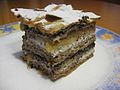 Prekmurska Gibanica
 -
Me_imurska gibanica served in Croatia


.jpg)