Prostacyclin synthase: Difference between revisions
CSV import Tags: mobile edit mobile web edit |
CSV import |
||
| Line 27: | Line 27: | ||
[[Category:Enzymes]] | [[Category:Enzymes]] | ||
{{enzyme-stub}} | {{enzyme-stub}} | ||
<gallery> | |||
File:Prostacyclin_synthase_2IAG_Chiang_et_al.png|Prostacyclin synthase structure from 2IAG | |||
File:Thromboxane_synthesis.png|Thromboxane synthesis pathway | |||
File:Eicosanoid_synthesis.svg|Eicosanoid synthesis pathways | |||
</gallery> | |||
Latest revision as of 03:55, 18 February 2025
Prostacyclin synthase is an enzyme that in humans is encoded by the PTGIS gene. This enzyme belongs to the family of cytochrome P450 enzymes. It plays a crucial role in the biosynthesis of prostacyclin, a potent vasodilator and inhibitor of platelet aggregation.
Function[edit]
Prostacyclin synthase converts prostaglandin H2 (PGH2) to prostacyclin (PGI2). This reaction is a part of the eicosanoid synthesis pathway, which is essential for the production of various bioactive lipids that regulate a wide range of physiological processes, including inflammation, blood flow, and platelet function.
Structure[edit]
The prostacyclin synthase enzyme is a monomer with a molecular weight of approximately 55 kDa. It contains a heme prosthetic group, which is involved in the enzyme's catalytic activity.
Clinical significance[edit]
Alterations in prostacyclin synthase activity have been associated with various diseases, including cardiovascular disease, pulmonary hypertension, and cancer. In particular, decreased prostacyclin production due to reduced prostacyclin synthase activity is a common feature of atherosclerosis and thrombosis.
See also[edit]
References[edit]
<references group="" responsive="1"></references>

-
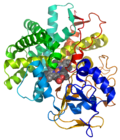 Prostacyclin synthase structure from 2IAG
 -
 Thromboxane synthesis pathway
 -
 Eicosanoid synthesis pathways


