4-Chlorokynurenine: Difference between revisions
CSV import |
CSV import |
||
| Line 32: | Line 32: | ||
[[Category:Neuroscience]] | [[Category:Neuroscience]] | ||
[[Category:NMDA receptor antagonists]] | [[Category:NMDA receptor antagonists]] | ||
<gallery> | |||
File:4-Chlorokynurenine.svg|4-Chlorokynurenine chemical structure | |||
File:4-Chlorokynurenineballstick.jpg|4-Chlorokynurenine ball and stick model | |||
File:Activated_NMDAR.svg|Activated NMDA receptor | |||
</gallery> | |||
Latest revision as of 02:14, 18 February 2025
A chemical compound used in research
4-Chlorokynurenine is a chemical compound that has been studied for its potential effects on the nervous system. It is a derivative of kynurenine, an intermediate in the tryptophan metabolism pathway. 4-Chlorokynurenine is of interest in neuroscience research due to its role as a prodrug for 7-chlorokynurenic acid, a potent antagonist of the NMDA receptor.
Chemical Structure[edit]
4-Chlorokynurenine is structurally similar to kynurenine, with the addition of a chlorine atom at the 4-position of the aromatic ring. This modification alters its pharmacological properties, making it a subject of interest in the study of neurotransmitter systems.
Mechanism of Action[edit]
4-Chlorokynurenine is metabolized in the body to produce 7-chlorokynurenic acid, which acts as an antagonist at the glycine site of the NMDA receptor. The NMDA receptor is a type of glutamate receptor that plays a crucial role in synaptic plasticity and memory function. By inhibiting this receptor, 4-chlorokynurenine may modulate excitatory neurotransmission and has been investigated for its potential therapeutic effects in neurological disorders.
Research and Applications[edit]
Research into 4-chlorokynurenine has focused on its potential use in treating conditions such as depression, schizophrenia, and neurodegenerative diseases. Its ability to cross the blood-brain barrier and be converted into an active NMDA receptor antagonist makes it a promising candidate for further study.
Safety and Toxicology[edit]
As with many experimental compounds, the safety profile of 4-chlorokynurenine is not fully established. Studies are ongoing to determine its potential side effects and toxicological properties in both animal models and human subjects.
Related pages[edit]
Gallery[edit]
-
 Chemical structure of 4-Chlorokynurenine
 -
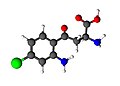 Ball-and-stick model of 4-Chlorokynurenine
 -
 Illustration of an activated NMDA receptor


-
4-Chlorokynurenine chemical structure
-
4-Chlorokynurenine ball and stick model
-
Activated NMDA receptor
