Potato skins: Difference between revisions
CSV import |
CSV import |
||
| Line 26: | Line 26: | ||
[[Category:American cuisine]] | [[Category:American cuisine]] | ||
{{food-stub}} | {{food-stub}} | ||
<gallery> | |||
File:Potato_skins_arranged_on_a_plate_as_an_appetizer.jpg|Potato skins arranged on a plate as an appetizer | |||
</gallery> | |||
Latest revision as of 22:03, 16 February 2025
Potato skins are a popular appetizer and snack food made from the outer layer of a potato. They are often served in restaurants and bars, and are also a common homemade dish.
History[edit]
The exact origin of potato skins is unclear, but they likely emerged as a way to utilize the entire potato and reduce food waste. They became popular in the United States in the 1970s and 1980s, particularly in casual dining establishments.
Preparation[edit]
Potato skins are typically prepared by first baking or boiling whole potatoes. Once cooked, the potatoes are cut in half and the inner flesh is scooped out, leaving a shell of skin and a thin layer of potato. The skins are then typically brushed with oil or butter and baked until crispy. They are often topped with ingredients such as cheese, bacon, sour cream, and green onions.
Nutritional Value[edit]
Potato skins are high in fiber and contain significant amounts of vitamin C, vitamin B6, potassium, and iron. However, they can also be high in fat and calories, particularly when topped with cheese and bacon.
Variations[edit]
There are many variations of potato skins, including those topped with chili, guacamole, salsa, or other ingredients. Some versions are made with sweet potatoes instead of regular potatoes.
In Popular Culture[edit]
Potato skins have been featured in numerous television shows and movies, often as a symbol of casual, comfort food. They are also a popular item at Super Bowl parties and other sports-viewing events.
See Also[edit]

-
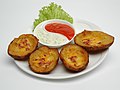 Potato skins arranged on a plate as an appetizer

